


 Agriculture
  Manufacturing
 Automobile
 Pharmaceutical
 RealEstate
 Education
 Events
 Industry 4.0
 Lab Setup
 Training
 Product Demonstrator
 Remote Assistance (MR)
 Virtual Showroom
 Virtual Try on
 Print Media
  Virtual Reality

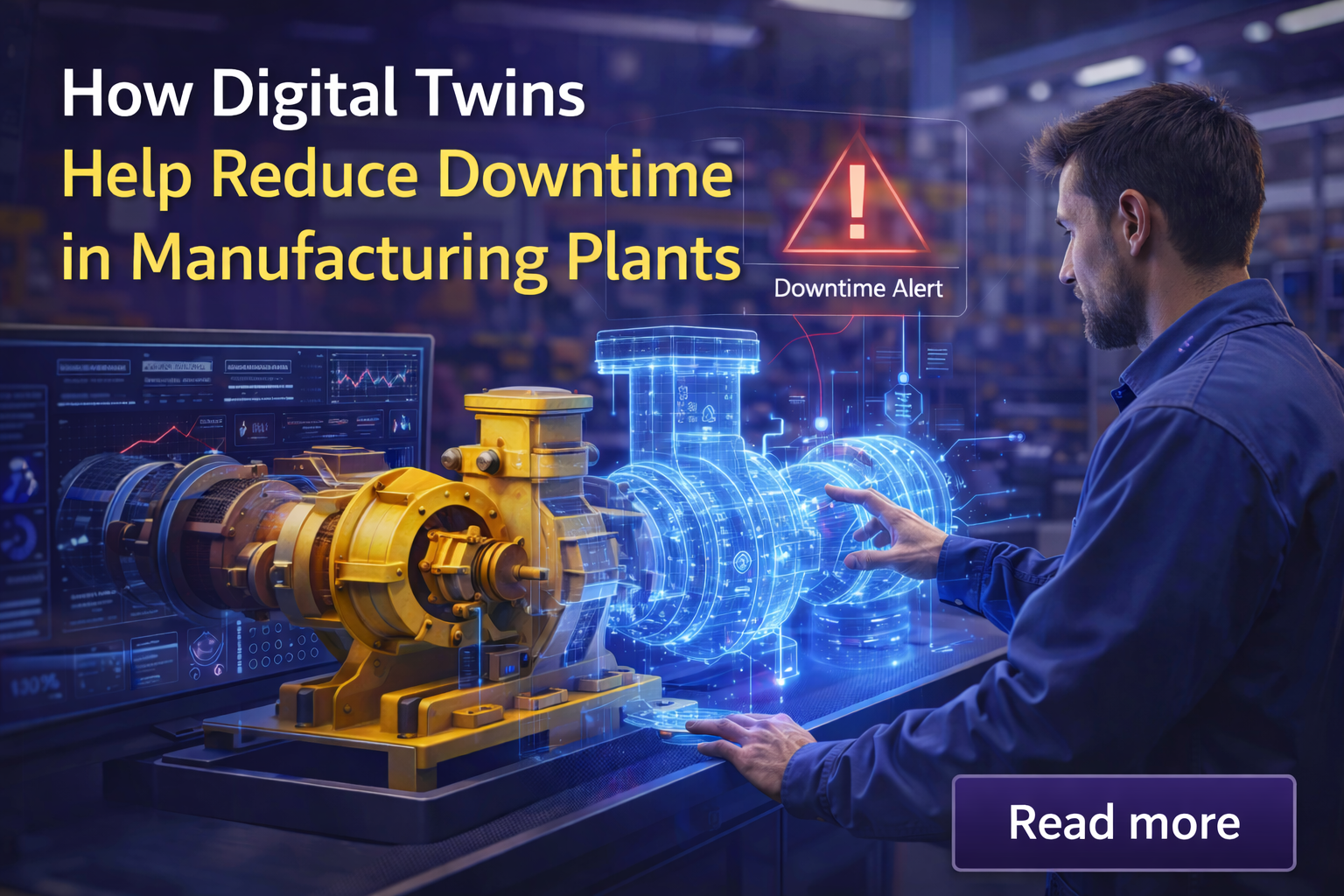
Downtime remains one of the biggest obstacles in manufacturing. Even short interruptions can impact production flow and delivery timelines. With the rise of smart technologies, Digital Twins are emerging as a powerful tool that helps industries monitor systems, plan proactively, and reduce operational disruptions.
This guide explores how Digital Twins support downtime reduction—along with real-world applications across multiple industries.
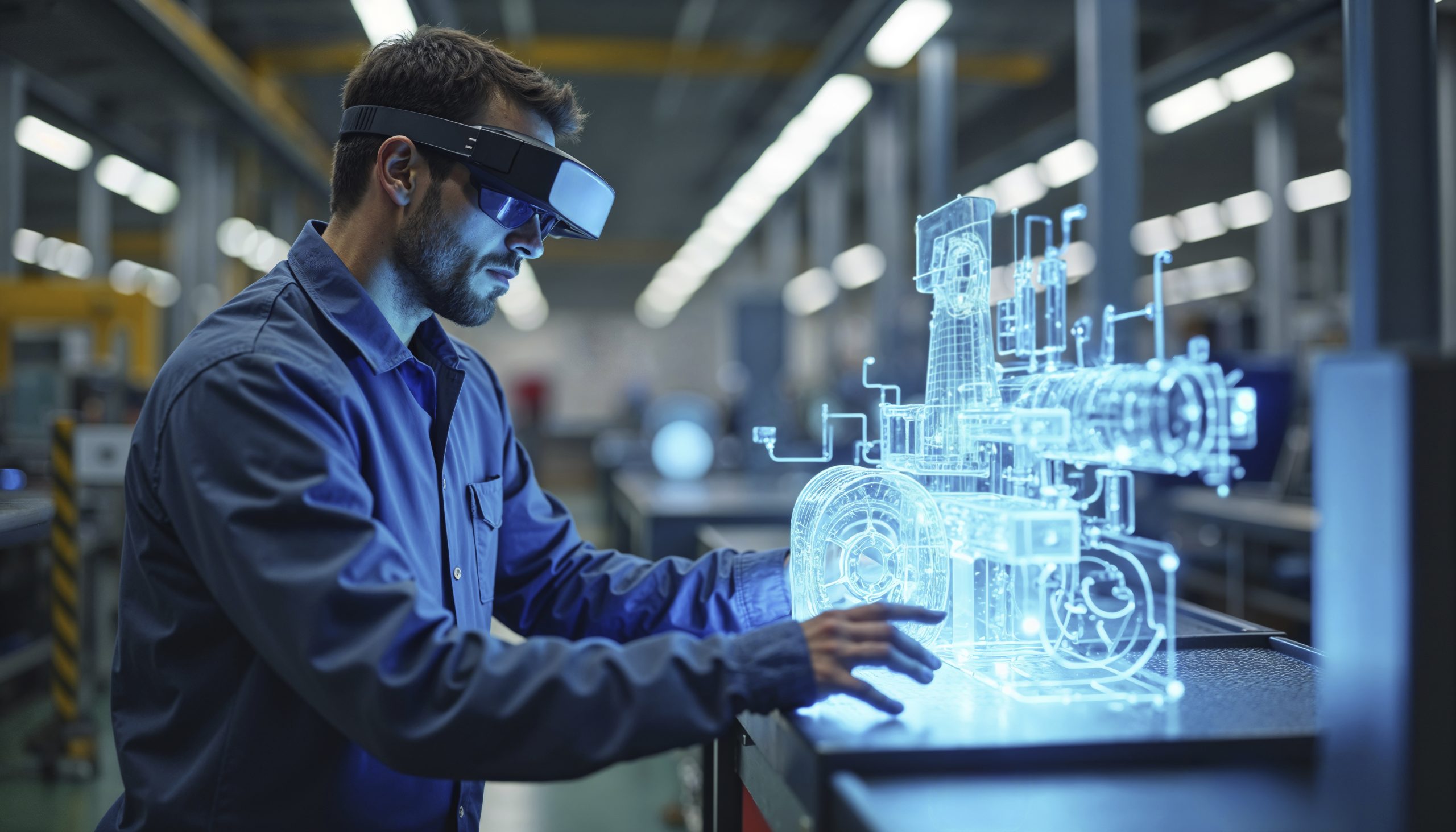
What Is a Digital Twin in Manufacturing?
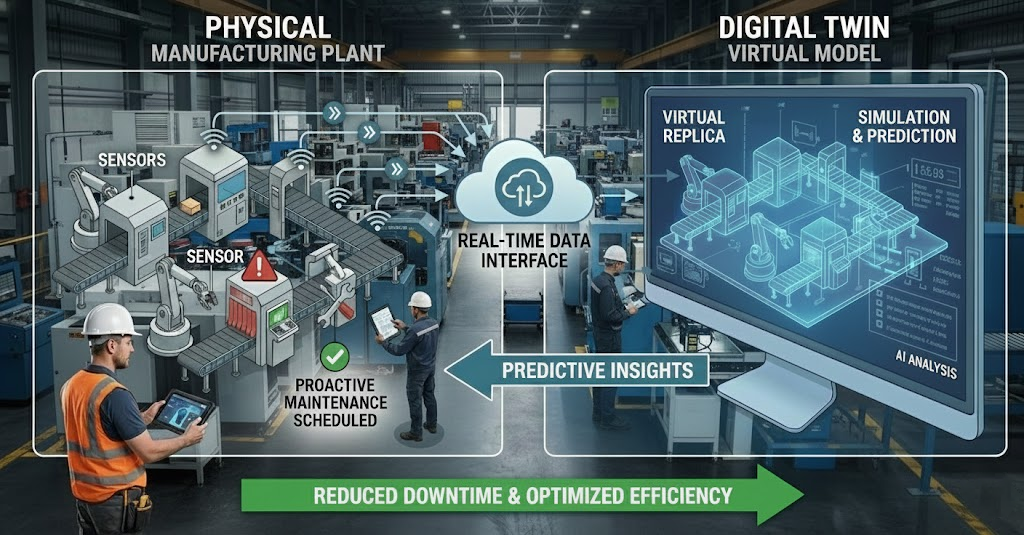
A Digital Twin is a virtual model of a machine, system, or process that continuously mirrors real-world behavior through connected sensors and data systems.
It allows teams to:
- Monitor operational conditions
- Predict potential slowdowns
- Simulate changes virtually
- Optimize workflows
- Improve decision-making
This deeper visibility helps industries prevent interruptions and maintain smooth operations.
Why Digital Twins Matter for Downtime Reduction
Downtime—planned or unplanned—often occurs due to equipment fatigue, untimely maintenance, environmental disturbances, or process variations. Digital Twins help organizations stay ahead by offering data-backed insights, virtual testing, and real-time monitoring.
How Digital Twins Help Reduce Downtime in Manufacturing Plants
1. Real-Time Condition Monitoring for Faster Response
A Digital Twin monitors parameters like temperature, vibration, pressure, load, and energy usage.
Any deviation is flagged early, giving teams a chance to respond before slowdowns occur.
Industry Examples:
- Automotive: Detects robot arm misalignment or welding inconsistencies.
- Electronics Manufacturing: Tracks overheating of high-speed pick-and-place machines.
- Pharmaceuticals: Monitors cleanroom equipment and controlled environments.
Benefit:
✔ Early intervention reduces unexpected pauses.
2. Virtual Testing Before Making Changes
Industries often modify workflows, tools, or production setups.
A Digital Twin helps simulate different scenarios before actual implementation.
Industry Examples:
- Aerospace: Test assembly sequence changes for complex components.
- FMCG: Evaluate packaging-line speed adjustments.
- Heavy Machinery: Simulate load-bearing conditions for large fabrication units.
Benefit:
✔ Reduces risk during process optimization.
3. Predictive Maintenance Based on Real Data
Instead of fixed maintenance intervals, Digital Twins help schedule maintenance based on actual machine condition.
Industry Examples:
- Oil & Gas: Predict wear in pumps, compressors, and drilling equipment.
- Steel & Metals: Monitor rolling mills and blast furnace components.
- Food Processing: Track conveyor systems and temperature-controlled machinery.
Benefit:
✔ Timely maintenance without halting production.
4. Root Cause Identification Through Data Visualization
When a disruption occurs, Digital Twins simplify analysis by recreating the conditions that led to the issue.
Industry Examples:
- Chemical Plants: Identify process deviations in mixing/reactor units.
- Textile Mills: Track tension variation in high-speed looms.
- Automotive: Diagnose irregularities in robotic assembly cells.
Benefit:
✔ Faster troubleshooting and reduced downtime duration.
5. Better Planning With Data-Backed Insights
Digital Twins combine historical, real-time, and simulated data to help industries allocate workloads and plan production more efficiently.
Industry Examples:
- Semiconductor: Plan equipment usage during peak fabrication cycles.
- Pharma: Coordinate batch manufacturing to avoid bottlenecks.
- Logistics & Warehousing: Optimize automated material handling equipment.
Benefit:
✔ Smoother operations and fewer workflow interruptions.
6. Lifecycle Understanding for Long-Term Reliability
Digital Twins give industries visibility into the entire lifecycle of machines—from commissioning to operation and performance optimization.
Industry Examples:
- Power Plants: Track turbine, boiler, and generator lifecycle behavior.
- Renewable Energy: Monitor wind turbine performance and environmental impacts.
- Construction Equipment: Analyze usage patterns of cranes, excavators, and loaders.
Benefit:
✔ Better planning and sustainable equipment utilization.
7. Enhancing Workforce Capabilities
Operators can use a Digital Twin to learn machine behavior, response patterns, and safe operating methods—without disrupting actual production.
Industry Examples:
- Aviation Manufacturing: Training teams on assembly lines digitally.
- Food Industry: Teaching hygienic workflow procedures through simulations.
- Packaging Industry: Training operators to manage format-change cycles.
Benefit:
✔ Fewer human errors and safer operations.
8. Continuous Improvement & Innovation
Digital Twins support ongoing experimentation, allowing industries to test new ideas, analyze outcomes, and refine processes over time.
Industry Examples:
- Automotive: Fine-tune production planning for new vehicle models.
- Electronics: Reduce cycle time during board assembly optimization.
- Textile: Adjust run speeds to minimize fabric wastage.
Benefit:
✔ Improved productivity and operational confidence.
Industries Benefiting the Most From Digital Twins
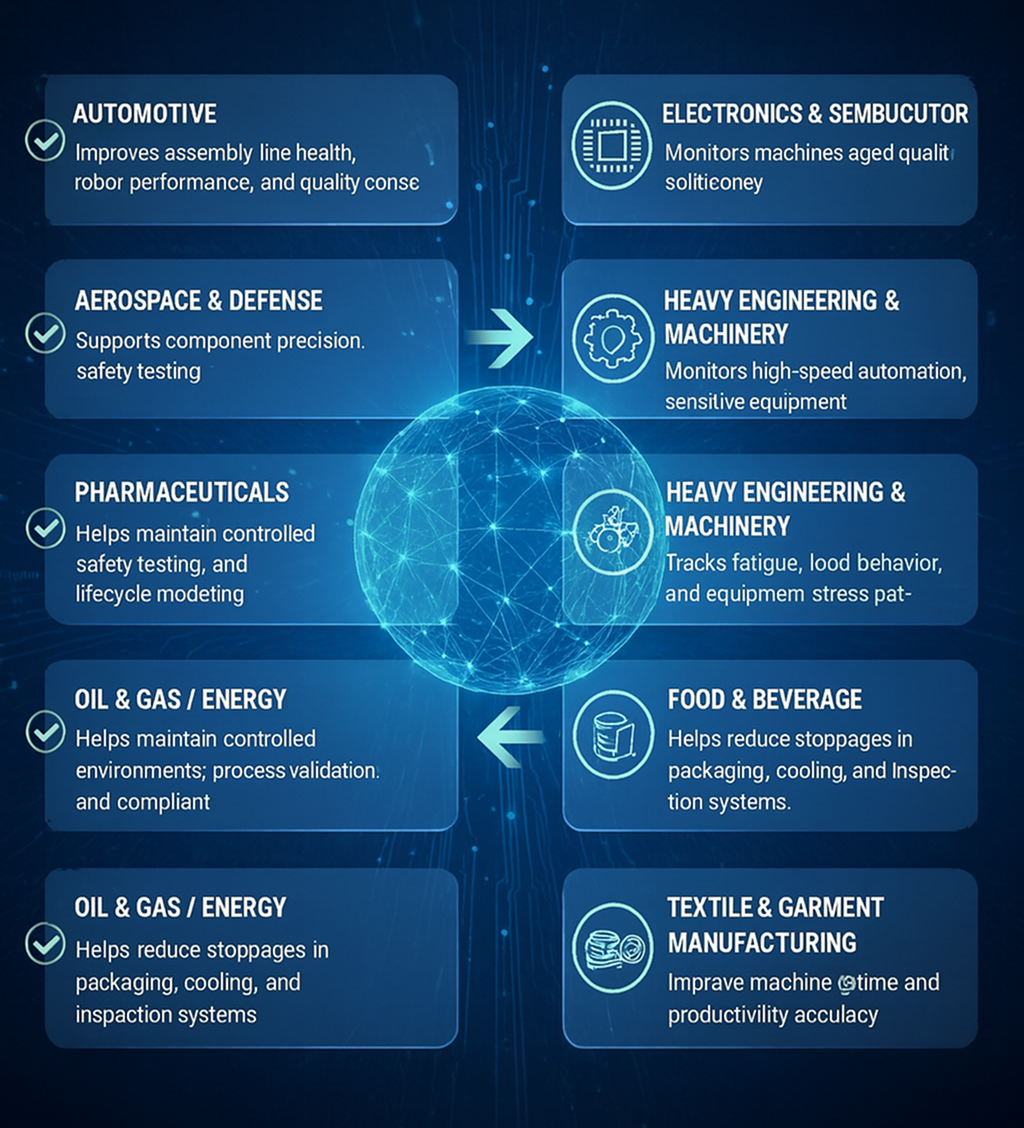
✔ Automotive
Improves assembly line health, robot performance, and quality consistency.
✔ Aerospace & Defense
Supports component precision, safety testing, and lifecycle modeling.
✔ Pharmaceuticals
Helps maintain controlled environments, process validation, and compliant manufacturing.
✔ Oil & Gas / Energy
Assists in optimizing drilling, refining, and power generation assets.
✔ Electronics & Semiconductor
Monitors high-speed automation, sensitive equipment, and cleanroom conditions.
✔ Heavy Engineering & Machinery
Tracks fatigue, load behavior, and equipment stress patterns.
✔ Food & Beverage
Helps reduce stoppages in packaging, cooling, and inspection systems.
✔ Textile & Garment Manufacturing
Improves machine uptime and production schedule accuracy.
These industries adopt Digital Twins because they require high reliability, minimal downtime, and continuous optimization.
Conclusion
Digital Twins give industries the ability to visualize, analyze, and improve their production environments with greater accuracy.
By offering real-time monitoring, virtual simulation, smarter maintenance planning, and cross-industry adaptability, Digital Twins play a key role in reducing downtime and strengthening operational efficiency.
As manufacturing evolves into a connected ecosystem, Digital Twins will continue enabling smoother, more predictable, and more resilient operations across multiple sectors.

 Contact Us