


 Agriculture
  Manufacturing
 Automobile
 Pharmaceutical
 RealEstate
 Education
 Events
 Industry 4.0
 Lab Setup
 Training
 Product Demonstrator
 Remote Assistance (MR)
 Virtual Showroom
 Virtual Try on
 Print Media
  Virtual Reality

Introduction
Construction projects are constantly changing. Every phase introduces new work zones, equipment, contractors, and potential hazards. Workers often move between different locations, interact with multiple teams, and perform tasks under varying site conditions. Because of this dynamic environment, preparing employees before they begin work is just as important as managing safety during construction.
Traditional safety training methods such as classroom presentations, printed manuals, toolbox talks, and videos continue to play an important role. However, many organizations are also exploring digital learning approaches that allow employees to experience realistic workplace scenarios before entering active construction sites.
Among these approaches, VR safety training for construction projects has become an important area of interest for organizations looking to strengthen workforce preparedness through immersive learning experiences.
Rather than replacing existing safety programs, virtual reality training complements traditional methods by providing employees with practical, visual, and scenario-based learning opportunities.
What Is VR Safety Training?
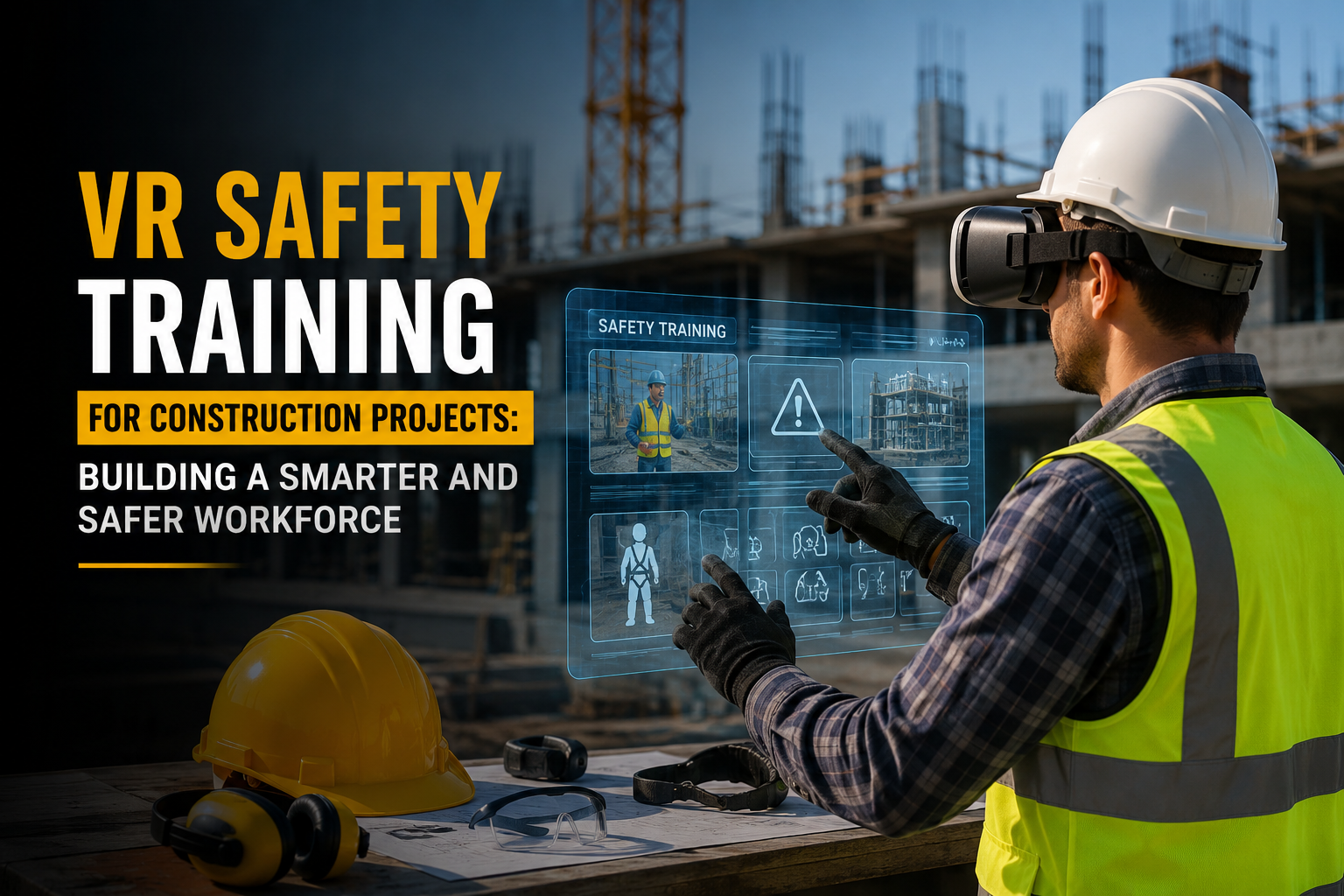
VR safety training uses virtual reality technology to create immersive environments where workers can experience realistic construction scenarios in a safe and controlled setting.
Instead of only reading procedures or watching demonstrations, participants can interact with virtual construction sites that represent everyday working conditions.
Depending on the training objective, employees may learn about:
- Site layouts
- Equipment operating areas
- Hazard identification
- Safe work practices
- Emergency response procedures
- Restricted access zones
- Personal protective equipment awareness
The objective is to improve understanding through experience rather than observation alone.
Why Is Safety Training Critical in Construction?
Construction remains one of the most operationally complex industries because work environments continuously evolve throughout a project’s lifecycle.
Workers regularly encounter:
- Multiple contractors working simultaneously
- Heavy machinery movement
- Temporary structures
- Excavation activities
- Working at heights
- Confined workspaces
- Material handling operations
Because these conditions change frequently, employees benefit from training that helps them understand both workplace procedures and site-specific environments.
Well-structured safety training supports employees in developing awareness before they begin performing operational tasks.
How Does Virtual Reality Improve Construction Safety Training?
Virtual reality introduces a different way of learning by allowing workers to experience situations rather than simply hearing or reading about them.
Interactive Learning
Employees participate directly in simulated environments instead of passively consuming training materials.
Learning through interaction often makes workplace procedures easier to understand because participants can observe how situations develop within realistic project settings.
Visual Hazard Recognition
Construction sites contain numerous temporary and changing hazards.
Virtual reality allows workers to explore digital job sites where they can identify:
- Unsafe work areas
- Equipment movement zones
- Access restrictions
- Potential workplace hazards
This visual approach helps employees become familiar with site conditions before arriving at the project.
Scenario-Based Practice
Not every workplace situation can be recreated safely during traditional training.
Virtual environments allow organizations to create realistic scenarios that employees can experience without affecting active project operations.
These simulations help reinforce understanding of workplace procedures and decision-making processes.
Consistent Learning Across Teams
One challenge in construction workforce training is maintaining consistency across projects, contractors, and locations.
VR training provides standardized learning experiences where every participant receives the same guidance, scenarios, and training objectives.
This consistency supports workforce alignment across multiple project sites.
A Practical Example
Imagine a contractor joining a large commercial construction project.
Before entering the active worksite, the employee participates in a virtual training session.
Within the simulation, the worker can:
- Navigate the construction site
- Understand designated access routes
- Recognize restricted work zones
- Observe equipment operating areas
- Practice emergency evacuation procedures
- Review site-specific safety expectations
By experiencing the environment virtually, the employee develops familiarity with the project before entering the actual construction site.
This creates a stronger foundation for workplace awareness while supporting existing safety orientation programs.
Why Construction Companies Are Exploring Immersive Safety Training
Construction organizations continue to look for training approaches that improve workforce understanding without interrupting project schedules.
Immersive learning supports this objective by making training more visual, practical, and engaging.
Many organizations are evaluating immersive technologies to support:
- Construction workforce onboarding
- Site induction programs
- Hazard awareness
- Contractor orientation
- Safety culture initiatives
- Workforce readiness
- Practical learning experiences
These approaches complement existing safety frameworks rather than replacing them.
Conclusion
Construction safety training continues to evolve as projects become more complex and workforce expectations change. While traditional training methods remain valuable, immersive learning technologies provide an additional way to help workers understand site conditions, recognize hazards, and become familiar with workplace procedures before entering active construction environments.
Organizations exploring modern training approaches can evaluate how virtual reality supports practical learning alongside existing safety programs, helping create more engaging and consistent training experiences across projects.
If you’re exploring immersive learning for your workforce, discover how VR-based construction training solutions can support your safety training initiatives or request a free demo to experience immersive construction training in action.

 Contact Us