

 Agriculture
  Manufacturing
 Automobile
 Pharmaceutical
 RealEstate
 Education
 Events
 Industry 4.0
 Lab Setup
 Training
 Product Demonstrator
 Remote Assistance (MR)
 Virtual Showroom
 Virtual Try on
 Print Media
  Virtual Reality

Introduction
Standard Operating Procedures (SOPs) form the foundation of pharmaceutical manufacturing. Every production stage, quality process, equipment operation, and cleaning activity follows documented procedures designed to maintain consistency across operations.
Although SOPs are well documented, helping employees understand and apply them consistently remains an ongoing training objective. Traditional methods such as classroom sessions, printed documents, and presentations continue to play an important role, but many pharmaceutical organizations are also exploring more interactive approaches to workforce learning.
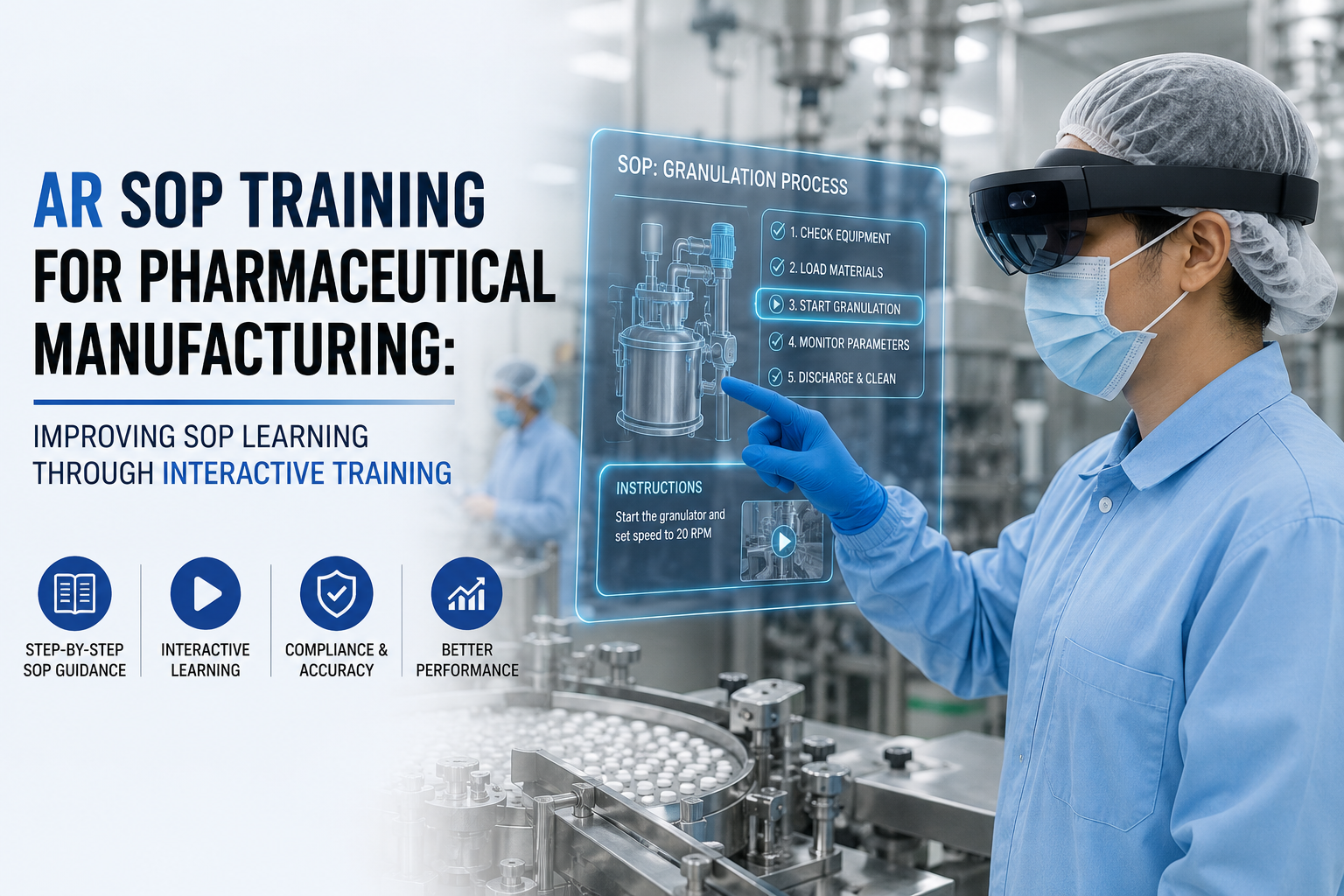
One approach gaining attention is AR SOP training for pharmaceutical manufacturing. By combining digital instructions with real-world environments, Augmented Reality (AR) helps employees visualize procedures, understand task sequences, and become familiar with operational workflows in a structured learning environment.
What Is AR SOP Training?
AR SOP training is a learning approach that uses Augmented Reality to present digital instructions, visual guidance, and process information alongside physical equipment or work environments.
Instead of relying only on printed documents or presentations, employees can interact with visual content while learning operational procedures.
AR-based learning may include:
- Step-by-step process guidance
- Equipment familiarization
- Visual workflow instructions
- Interactive learning modules
- Process demonstrations
- Digital checklists during training
The objective is to make SOP learning easier to understand through visual and contextual guidance.
Why Are SOPs Important in Pharmaceutical Manufacturing?
Short Answer
Standard Operating Procedures help create consistency by documenting how manufacturing activities should be performed. They provide employees with structured guidance for carrying out operational tasks in a standardized manner.
Across pharmaceutical facilities, SOPs support activities such as:
- Equipment operation
- Manufacturing processes
- Cleaning procedures
- Material handling
- Documentation practices
- Quality-related activities
Because multiple teams may perform similar activities across different shifts, consistent understanding of SOPs is essential for effective workforce training.
Challenges with Traditional SOP Training
Traditional training methods remain valuable, but some organizations encounter challenges when explaining complex procedures using documents alone.
Common situations include:
Learning Through Text-Heavy Documents
Lengthy SOP documents may require additional explanation before employees fully understand process sequences.
Limited Process Visualization
Some procedures involve multiple steps, equipment interactions, or workflow dependencies that are easier to understand visually.
Different Learning Styles
Employees absorb information differently. While some prefer written material, others learn more effectively through demonstrations and practical experiences.
Maintaining Training Consistency
When different trainers explain procedures in different ways, learning experiences may vary across departments or locations.
These challenges encourage organizations to evaluate complementary learning approaches that improve understanding without replacing established SOP documentation.
How AR Supports SOP Training
Augmented Reality helps connect written procedures with visual learning experiences.
Visual Process Guidance
Employees can view digital instructions alongside equipment or training environments, making it easier to understand task sequences.
Step-by-Step Learning
Complex procedures can be divided into manageable learning stages, allowing participants to focus on one activity at a time before moving to the next.
Equipment Familiarization
AR enables employees to explore equipment components and operational workflows in a visual format before performing practical activities.
Interactive Learning Experience
Instead of passively reading instructions, learners engage with digital content that encourages observation, interaction, and understanding.
A Practical Example
Imagine a new technician joining a pharmaceutical manufacturing facility and learning a cleaning procedure for production equipment.
Traditionally, the technician might review printed SOPs, attend classroom sessions, and observe an experienced operator before performing the task.
With an AR-supported training environment, the technician can:
- View the equipment with digital overlays highlighting key components.
- Follow each procedural step in sequence.
- Understand where inspections or verification points occur.
- Review safety reminders at the relevant stage of the workflow.
- Repeat the learning experience until confident with the process.
This approach complements existing SOP documentation by adding visual context to the learning experience rather than replacing approved procedures.
Key Benefits of AR SOP Training
Organizations exploring pharmaceutical workforce training solutions often consider AR because it can support learning through visualization.
Potential applications include:
- Structured employee onboarding
- Process familiarization
- Equipment training
- SOP awareness sessions
- Cross-functional workforce learning
- Refresher training programs
By presenting information in an interactive format, AR can help employees build a clearer understanding of operational procedures.
Conclusion
Standard Operating Procedures are essential to pharmaceutical manufacturing, but effective training depends on how clearly employees understand and apply them in day-to-day operations. While traditional training methods remain important, Augmented Reality adds an interactive layer that helps learners visualize procedures, equipment, and workflows in a practical way.
As pharmaceutical organizations continue to modernize workforce development, AR SOP training offers a structured approach to support process understanding, consistent learning, and employee readiness alongside existing training programs. Organizations exploring immersive training technologies can Request a Free Demo to see how interactive AR-based learning can complement pharmaceutical workforce training and SOP education.

 Contact Us