

 Agriculture
  Manufacturing
 Automobile
 Pharmaceutical
 RealEstate
 Education
 Events
 Industry 4.0
 Lab Setup
 Training
 Product Demonstrator
 Remote Assistance (MR)
 Virtual Showroom
 Virtual Try on
 Print Media
  Virtual Reality

Introduction
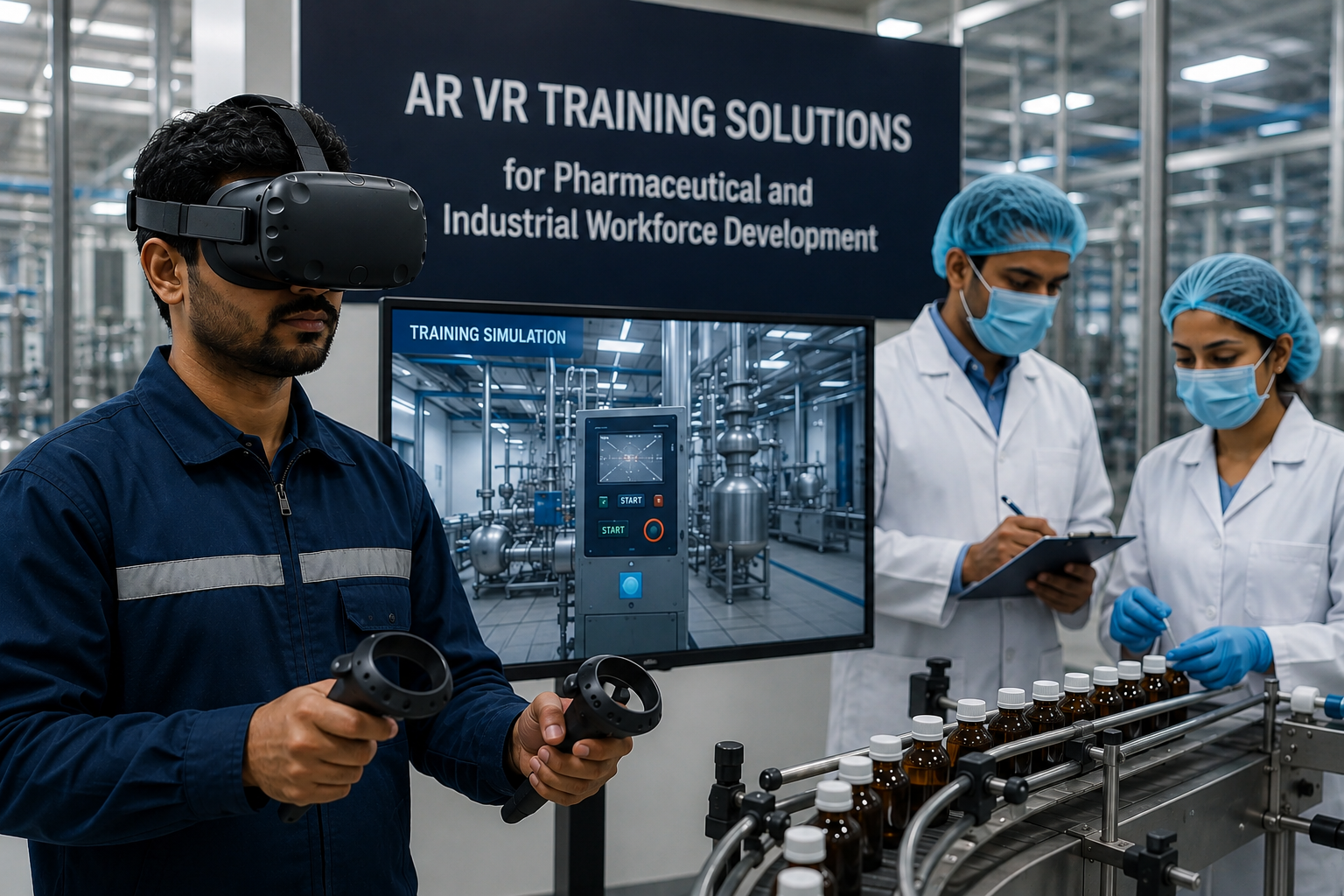
Hyderabad has a diverse industrial ecosystem spanning pharmaceuticals, healthcare, manufacturing, engineering, biotechnology, and technology. As organizations in these sectors adopt new equipment and digital workflows, workforce training also needs to evolve.
Employees may need to understand complex machinery, production processes, safety procedures, maintenance activities, and operational workflows before moving into hands-on environments.
Traditional classroom instruction, SOPs, demonstrations, and supervised practice remain important. However, AR VR training solutions Hyderabad can add an interactive learning layer that helps employees visualize equipment, processes, and workplace scenarios before or alongside practical training.
The value of immersive training is not simply the use of a headset. It is the ability to create a learning experience around a specific business or workforce requirement.
Where AR and VR Can Support Industrial Workforce Training
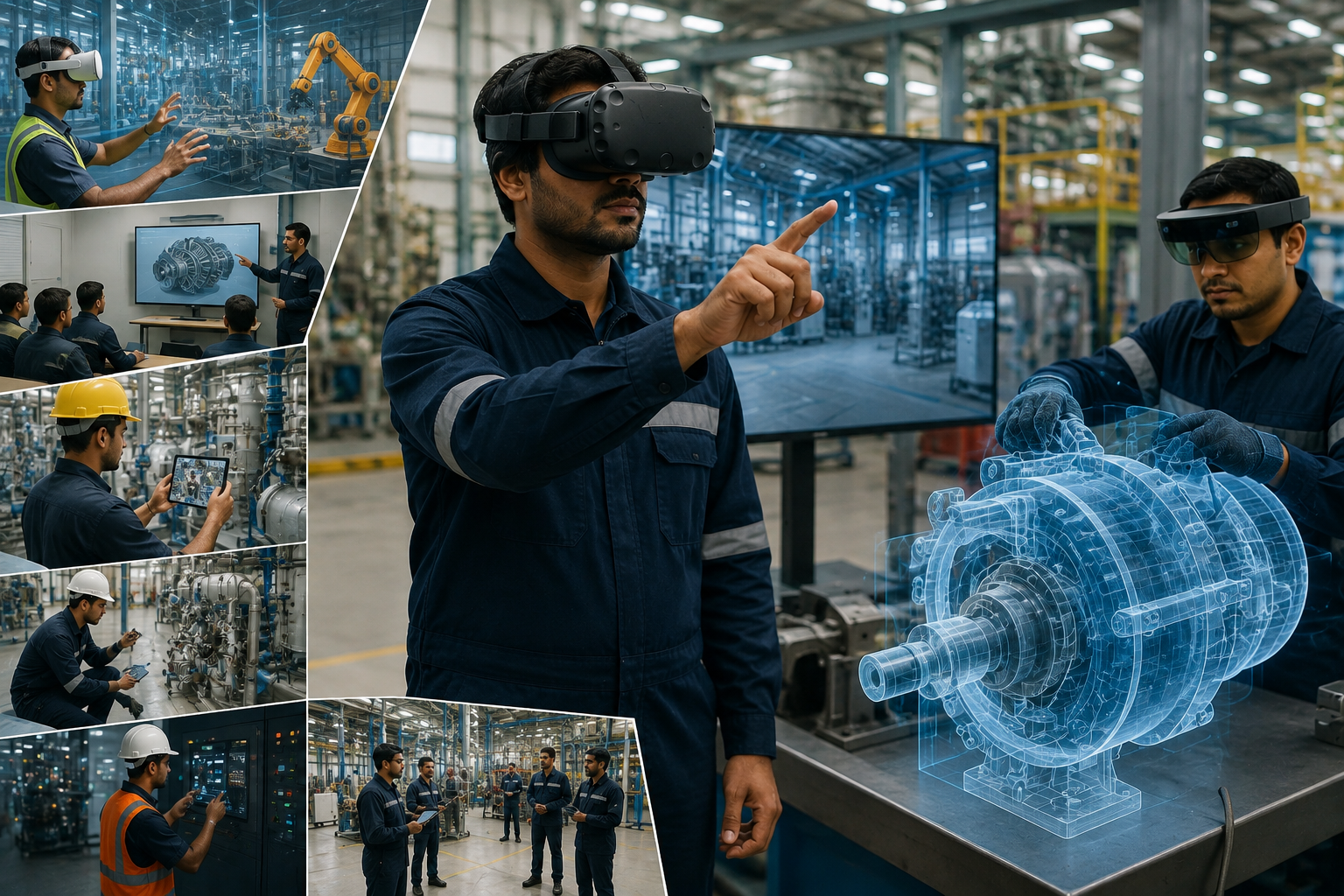
AR and VR are useful in different training situations.
Virtual Reality creates a simulated environment where learners can explore facilities, equipment, processes, and scenarios.
Augmented Reality can place digital information or instructions within a physical environment.
Mixed Reality can combine physical and digital elements for more interactive equipment and process learning.
For organizations looking for VR training solutions Hyderabad, the appropriate technology should therefore be selected according to the learning objective rather than the technology itself.
Common applications include:
- Equipment familiarization
- Process training
- Operator onboarding
- Maintenance learning
- Safety awareness
- Emergency scenario training
- SOP learning
- Technical workforce development
Pharmaceutical Training: A Strong Use Case for Immersive Learning
Pharmaceutical manufacturing involves specialized equipment and documented processes. Employees may need to understand machine components, operating sequences, cleaning procedures, maintenance activities, and workplace requirements.
Immersive learning can provide a visual environment for introducing these concepts.
For example, a VR module can allow an operator to explore a simulated machine, identify components, understand an operating sequence, and review selected scenarios before practical training.
Yeppar’s pharmaceutical solutions include VR and MR training applications for equipment such as blister packaging machines, Fette Compacting machines, tablet machines, and capsule-filling equipment.
This makes pharmaceutical VR training Hyderabad a relevant commercial search area for organizations evaluating modern workforce development approaches.
Connecting SOP Learning With Visual Experiences
SOPs provide documented instructions, but some processes are easier to understand when employees can see the relationship between individual steps and physical equipment.
An immersive learning module can support this by presenting a process as a visual sequence.
A training experience could guide an employee through:
- Identifying the relevant equipment.
- Understanding the sequence of activities.
- Reviewing selected process stages.
- Recognizing relevant safety considerations.
- Practicing the workflow in a simulated environment.
- Completing a trainer-led assessment.
This approach does not replace approved SOPs. Instead, it can provide additional context that supports understanding during workforce training.
How VR Can Support Employee Onboarding
New employees often need to become familiar with facilities, equipment, workflows, and workplace expectations.
A digital environment can provide an initial introduction before the employee begins practical activities.
For example, a new technician could virtually explore a production area, identify equipment locations, understand selected workflows, and review workplace scenarios before entering the physical environment.
This type of learning can be incorporated into an organization’s broader onboarding program and repeated for future employee groups.
Safety Training Through Immersive Scenarios
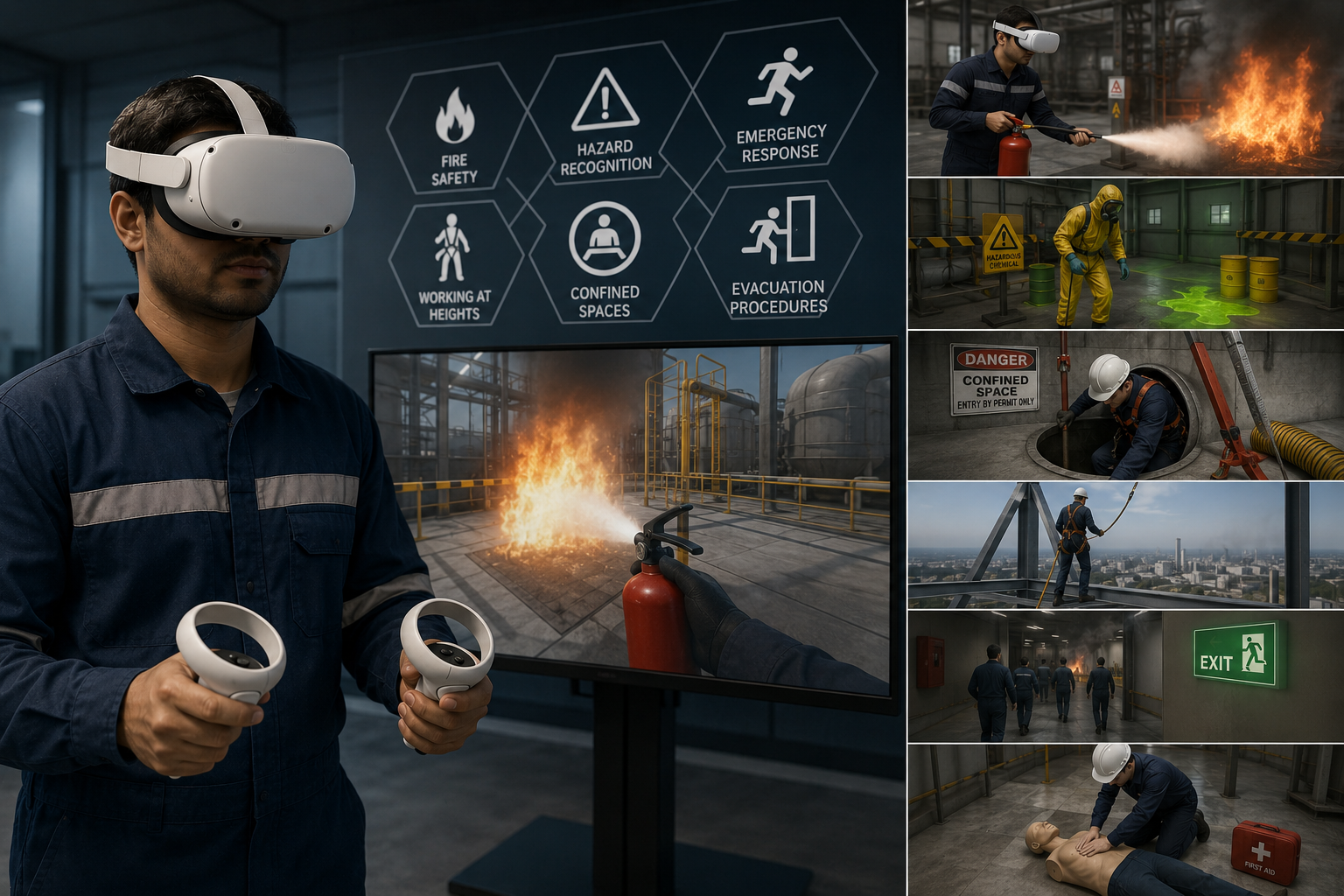
Safety learning is another area where VR can provide a controlled environment for scenario-based practice.
Organizations can develop simulations around selected situations such as:
- Fire safety
- Hazard recognition
- Emergency response
- Working at heights
- Confined spaces
- Equipment-related safety
- Evacuation procedures
Yeppar’s VR safety training offering includes HSE training, hazard recognition, fire safety, fall protection, working-at-height, confined-space, and emergency training scenarios.
The objective is to complement existing safety programs by providing an additional opportunity for employees to experience selected scenarios virtually.
Choosing Between AR, VR and MR
There is no single technology that fits every training requirement.
| Training Requirement | Potential Approach |
|---|---|
| Fully simulated workplace | VR |
| Facility walkthrough | VR |
| Equipment familiarization | VR / MR |
| Digital guidance around physical equipment | AR / MR |
| Emergency scenario practice | VR |
| Step-by-step physical task guidance | AR / MR |
| Process visualization | VR / MR |
For example, an organization may use VR for initial equipment familiarization and AR or MR for guided learning around a physical machine.
What Should Hyderabad Enterprises Evaluate Before Investing?
Organizations considering AR training solutions Hyderabad should begin with the training requirement.
Define the Learning Objective
Determine whether the objective is onboarding, equipment training, safety awareness, maintenance learning, process understanding, or another specific skill.
Identify the Workforce
The learning experience should reflect the requirements of operators, technicians, engineers, supervisors, contractors, or other employee groups.
Consider Scalability
A solution designed for one training session may have limited value if it cannot support additional teams, facilities, or learning modules.
Review Content Requirements
Immersive training is most useful when the content reflects the actual equipment, process, workflow, or scenario being taught.
Consider Existing Systems
Organizations may also evaluate how immersive training can fit into existing learning and operational environments. Yeppar describes AR, VR, and MR solutions that can be customized and integrated with technologies such as IoT, AI analytics, ERP, and LMS platforms.
From One Simulation to a Wider Training Program
Immersive learning does not have to begin as a large transformation project.
Organizations can start with one clearly defined training requirement and expand over time.
A possible progression could be:
Equipment Training → Process Learning → Safety Training → Maintenance Learning → Assessment
This allows organizations to identify where immersive technology adds practical value before expanding the program to additional workforce groups.
For enterprises researching industrial VR training Hyderabad or immersive training solutions Hyderabad, this use-case-first approach can make technology evaluation more focused.
How Yeppar Supports AR and VR Workforce Training
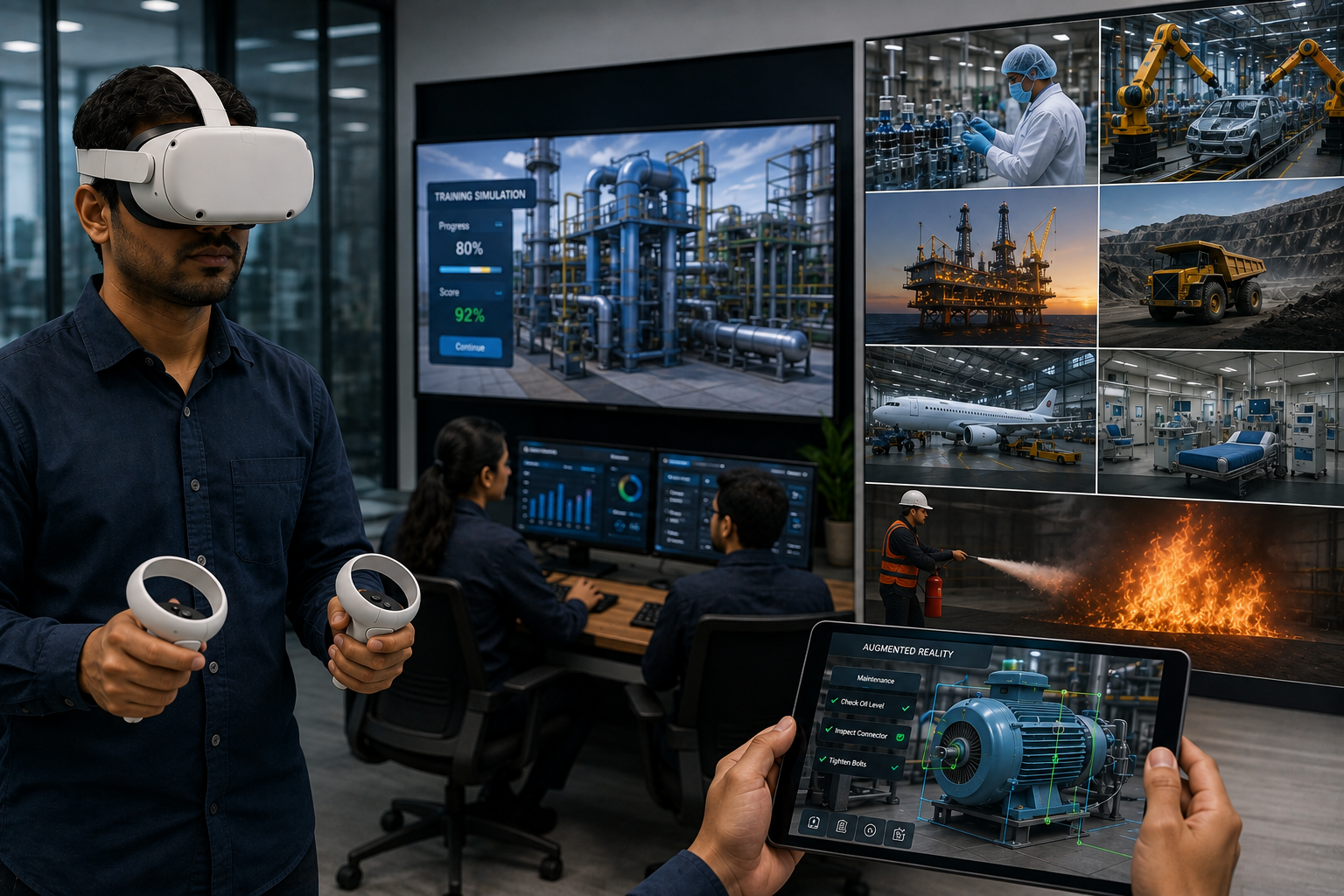
Yeppar develops B2B AR, VR, and MR solutions for workforce learning and industrial applications. Its training portfolio covers process and equipment training, workplace safety, emergency scenarios, training evaluation, and industry-specific learning experiences.
Yeppar also provides industry-focused solutions for pharmaceuticals, manufacturing, oil and gas, mining, aerospace, healthcare, and safety training.
Organizations evaluating immersive training solutions Hyderabad can Request a Free Demo to discuss their workforce requirements and explore whether AR, VR, or MR is appropriate for their specific training objective.
Conclusion
AR and VR can complement conventional workforce training by giving employees additional opportunities to visualize equipment, processes, workplace environments, and selected operational scenarios.
For pharmaceutical and industrial organizations, the most effective approach is to begin with a clearly defined learning requirement and then select the technology that supports that objective.
Organizations searching for AR VR training solutions Hyderabad can evaluate immersive learning for equipment familiarization, process training, safety awareness, onboarding, maintenance learning, and other workforce development requirements.
Request a Free Demo to explore how an immersive training approach can be aligned with your organization’s specific workforce and operational needs.
Frequently Asked Questions
What are AR VR training solutions in Hyderabad?
AR VR training solutions use augmented and virtual reality to create interactive learning environments for workforce development. They can support equipment training, process learning, safety awareness, onboarding, maintenance learning, and other industry-specific training requirements.
Which industries can use VR training solutions in Hyderabad?
Pharmaceuticals, manufacturing, healthcare, engineering, technology, energy, construction, and other industrial sectors can use VR where simulated or visual learning supports specific workforce training objectives.
How is VR used for pharmaceutical manufacturing training?
VR can recreate equipment and operational environments so employees can explore components, understand sequences, and practice selected workflows within a simulated learning environment.
What is the difference between AR and VR training?
VR creates a fully simulated environment, while AR adds digital information to the user’s physical environment. The appropriate option depends on the learning objective and workplace context.
Can AR and VR training be customized?
Yes. Enterprise training environments can be designed around specific equipment, processes, employee roles, workflows, and learning objectives.
Can immersive training integrate with existing systems?
Depending on the solution architecture, AR, VR, and MR applications can be designed to work with existing digital environments. Yeppar describes integration possibilities involving IoT, AI analytics, ERP, and LMS platforms.

 Contact Us