

 Agriculture
  Manufacturing
 Automobile
 Pharmaceutical
 RealEstate
 Education
 Events
 Industry 4.0
 Lab Setup
 Training
 Product Demonstrator
 Remote Assistance (MR)
 Virtual Showroom
 Virtual Try on
 Print Media
  Virtual Reality

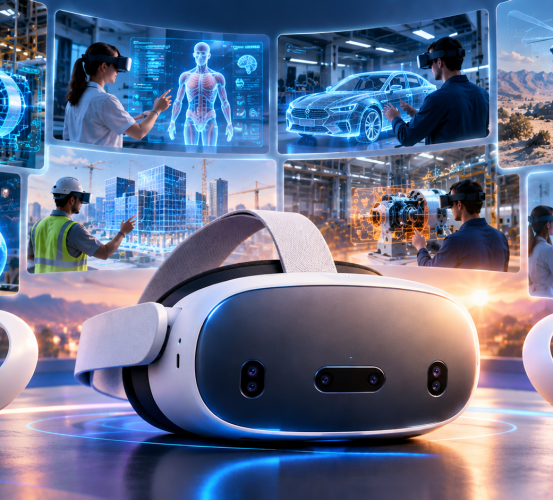
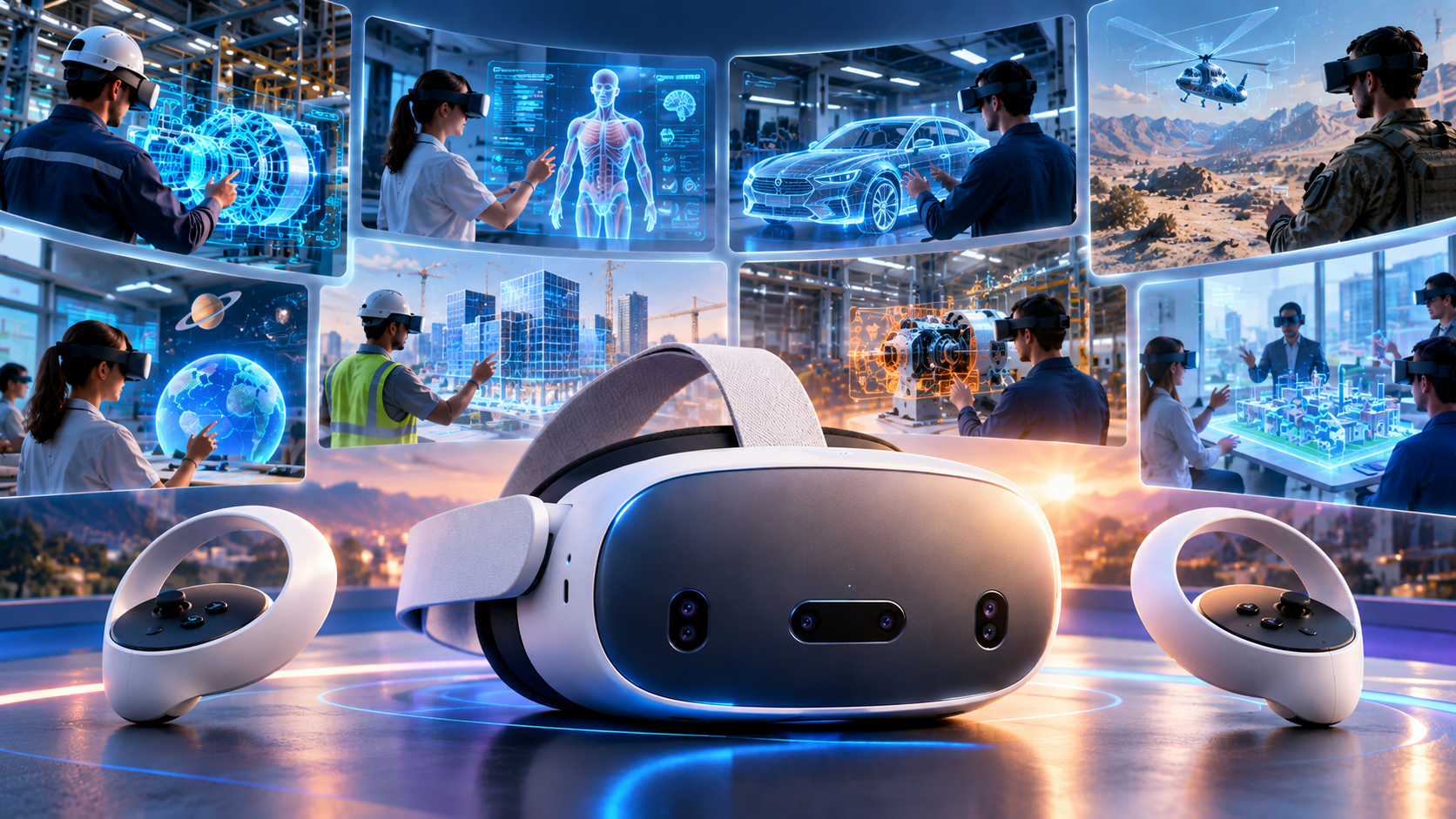
Virtual Reality (VR), Mixed Reality (MR), and Extended Reality (XR) are becoming increasingly relevant to the way organisations approach training, simulation, education, visualisation, collaboration, and digital experiences.
One of the best-known platforms in the VR ecosystem is Meta Quest. Meta’s current official documentation lists Meta Quest 3 and Meta Quest 3S as its Quest devices, while Meta is also expanding its VR ecosystem with a separate Meta VR Glasses product line running on Meta Horizon OS.
This naturally leads to an important question:
What is the future of Meta Quest, and what could a next-generation device such as Meta Quest 4 mean for businesses and industries?
As of September 2026, Meta has not officially announced Meta Quest 4 with a confirmed release date, price, or final specification sheet. Industry reporting has discussed a future gaming-focused Quest successor, but those details remain reported rather than officially confirmed.
For businesses, however, the conversation goes beyond the headset itself. The more important question is how the evolution of VR, MR, AI, spatial computing, and immersive applications could create new opportunities across industries.
Meta Quest 4 at a Glance
Before looking at the potential future of Meta Quest, it is useful to separate what is known from what remains unconfirmed.
| Information | Current Status |
|---|---|
| Meta Quest 4 officially announced | No |
| Official release date | Not announced |
| Official price | Not announced |
| Official specifications | Not available |
| Current Quest devices | Meta Quest 3 and Meta Quest 3S |
| Meta VR ecosystem | Continuing to expand |
| Future Quest development | Reported by industry sources |
| Potential enterprise applications | Dependent on hardware, software and use case |
Meta’s official developer documentation currently describes Meta Quest as a wireless, all-in-one VR device line powered by Meta Horizon OS. It lists Quest 3 and Quest 3S and identifies capabilities including head tracking, hand tracking, passthrough and 6 Degrees of Freedom (6DoF).
What Is Meta Quest?
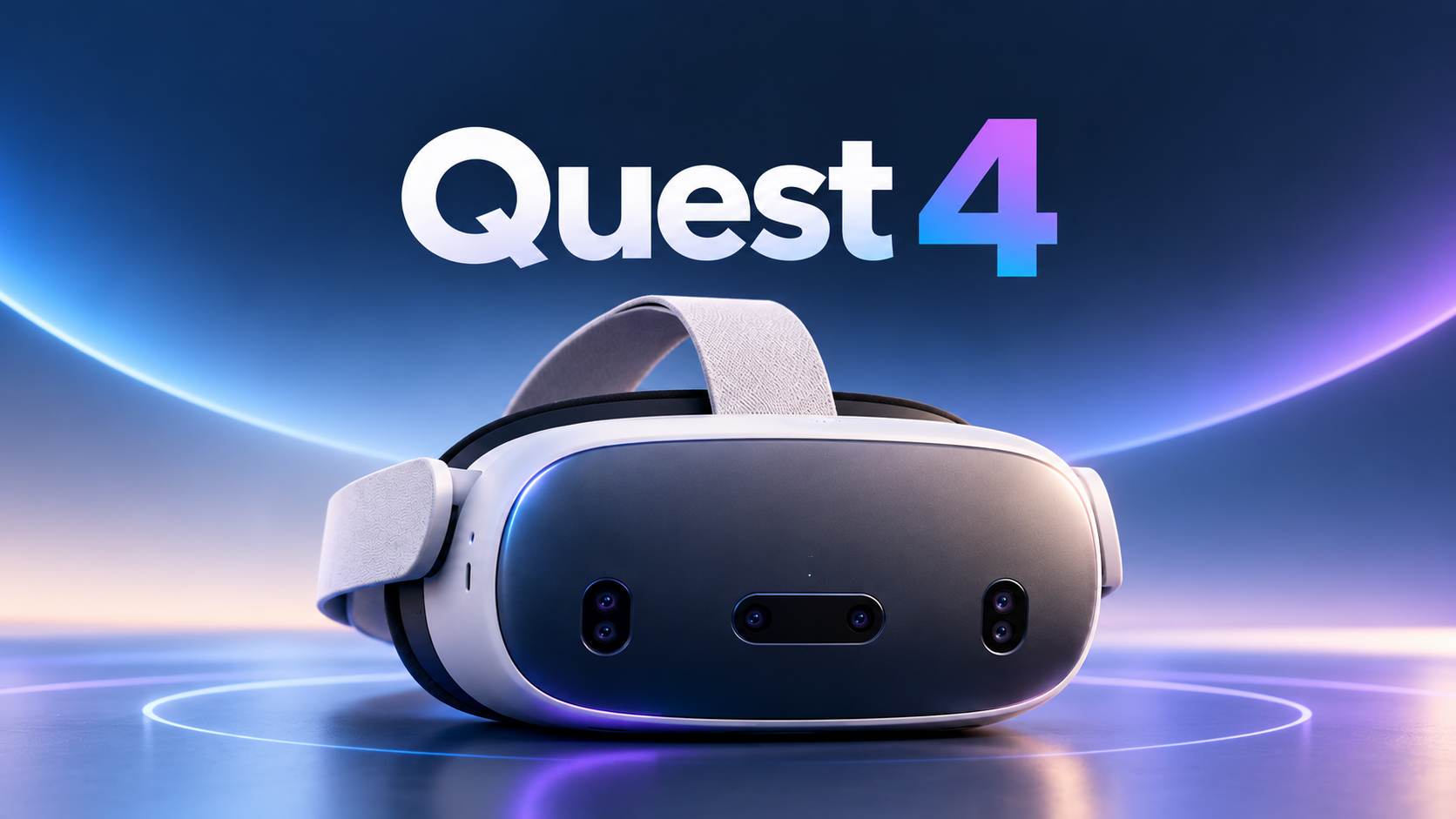
Meta Quest is a family of wireless, all-in-one VR devices designed to provide immersive virtual and mixed-reality experiences.
Current Quest devices combine:
- VR capabilities
- Mixed Reality features
- Head tracking
- Hand tracking
- Colour passthrough
- 6DoF tracking
- Standalone computing
- Access to the Meta Horizon OS ecosystem
Meta describes Quest as an all-in-one headset platform, with controllers as a primary input method and hand tracking also supported.
The platform is not limited to completely virtual environments. Through passthrough and Mixed Reality capabilities, developers can create experiences where digital content is presented alongside the user’s physical surroundings.
This creates possibilities beyond entertainment, including training, simulation, education, visualisation and interactive enterprise experiences.
Is Meta Quest 4 Officially Available?
No. Meta Quest 4 has not been officially announced as a retail product as of September 2026.
Meta’s official device documentation currently lists Meta Quest 3 and Meta Quest 3S rather than a Quest 4.
Meta’s September 2026 Connect event introduced Meta VR Glasses, which Meta describes as a new generation of Meta VR. Meta also stated that the new glasses are an addition to, rather than a replacement for, Meta Quest devices.
This distinction is important because there is a significant amount of online discussion around a possible Quest 4.
Currently unconfirmed:
- Meta Quest 4 release date
- Meta Quest 4 price
- Final processor
- Display technology
- Storage options
- Weight
- Field of view
- Controller configuration
- Final hardware design
- Final enterprise capabilities
Therefore, specifications published online should be treated carefully unless they are confirmed by Meta.
What Do We Know About the Future of Meta Quest?
Although Quest 4 has not been officially announced, industry reporting has discussed a future gaming-focused successor to Quest 3.
Some reporting has associated a future headset with the internal codename “Griffin” and suggested a potential release no earlier than the second half of 2027. Other reporting has discussed 2028 as a possible timeframe. These are reported roadmap details, not an official Meta launch announcement.
Meta itself has indicated that it continues to invest in new gaming hardware for its VR ecosystem. At Connect 2026, Meta described Meta VR Glasses as an addition to Quest and said gaming remains an important part of its VR ecosystem.
What does this mean?
It means businesses should distinguish between:
Confirmed information
Information published or announced by Meta.
Reported information
Information attributed to industry reporting or sources.
Speculation
Predictions about specifications, pricing or future features without reliable confirmation.
This distinction is particularly important when using information for technology planning or procurement decisions.
What Could We Expect From a Next-Generation Quest Device?
There is currently no official Quest 4 specification sheet. Therefore, the following areas should be viewed as potential directions for next-generation immersive technology, rather than confirmed Quest 4 features.
1. Increased Computing Performance
Future VR platforms may continue to improve computing performance to support increasingly detailed and interactive environments.
Potential applications could include:
- More complex simulations
- Detailed 3D environments
- Advanced visualisation
- AI-enabled applications
- Interactive training scenarios
- More sophisticated virtual environments
For industries, additional computing capability could become particularly relevant where VR applications involve complex equipment, large environments or detailed simulations.
2. More Advanced Mixed Reality
Mixed Reality combines digital content with elements of the physical environment.
Current Meta Quest devices already support colour passthrough and Mixed Reality development. Meta’s official documentation describes Quest devices as mixed-reality-capable wireless all-in-one devices.
Future developments in areas such as:
- Spatial understanding
- Environmental mapping
- Object recognition
- Tracking
- Depth sensing
could potentially expand how organisations use immersive technology.
Possible applications include:
- Industrial equipment visualisation
- Training environments
- Product demonstrations
- Digital twin experiences
- Workspace visualisation
- Interactive collaboration
However, these should not be interpreted as confirmed Meta Quest 4 specifications.
Meta Quest 4 and Enterprise XR
For businesses, the significance of a future VR device is not simply its processor, display or resolution.
The larger opportunity lies in combining immersive hardware with software and business systems.
A potential enterprise XR ecosystem can include:
VR + MR + AI + 3D Content + Digital Twins + Data + Enterprise Applications
This combination can support experiences designed around specific business processes.
For example, instead of watching a video about machine maintenance, a learner could potentially enter a virtual environment, interact with a digital representation of the machine and practise a procedure within a controlled simulation.
The headset provides the interface.
The application, content, workflow and integration create the business experience.
How Could Meta Quest Technology Be Used Across Industries?
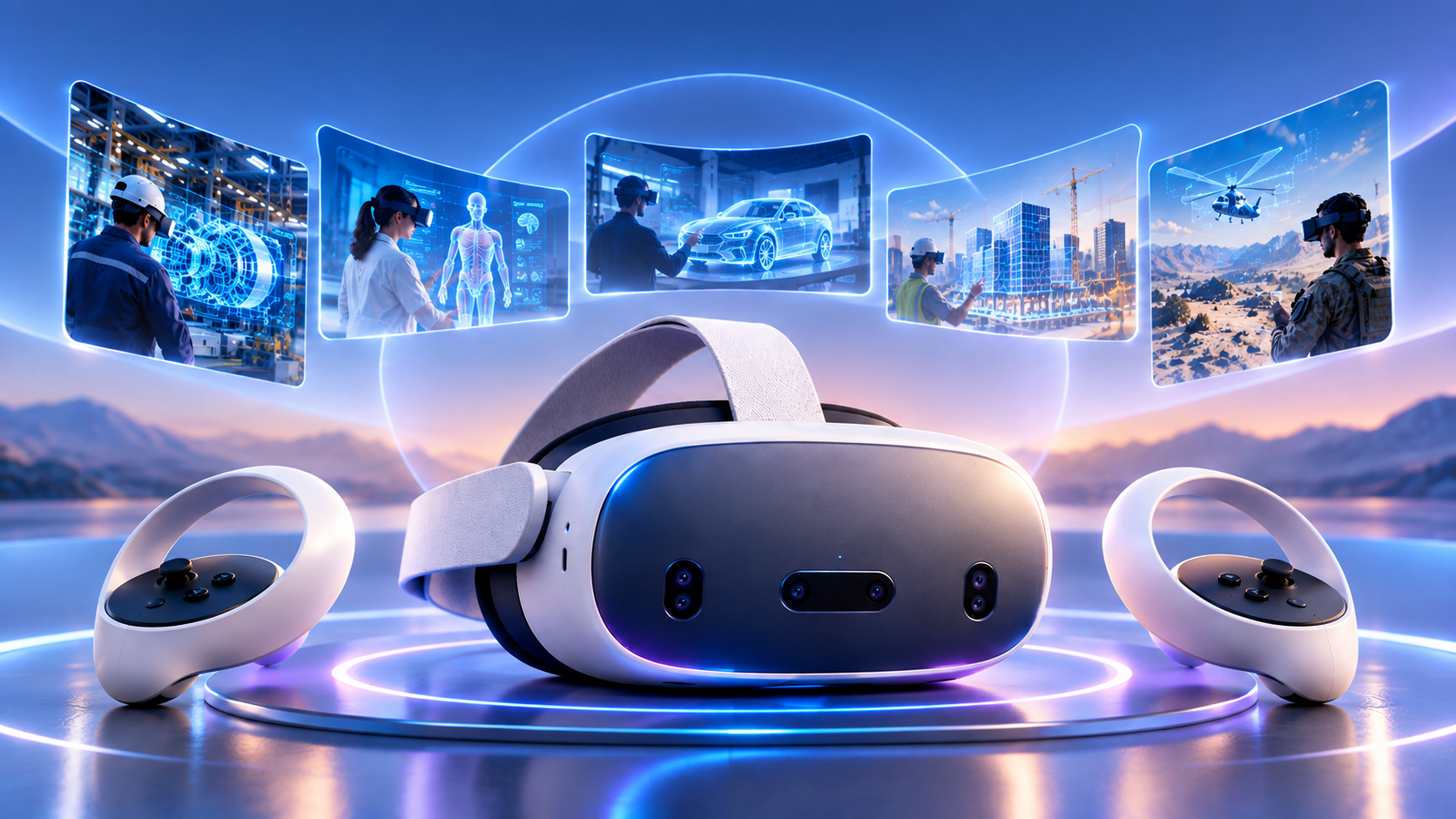
The potential applications of VR and XR extend across multiple sectors.
Manufacturing
Manufacturing organisations can explore immersive technology for:
- Machine familiarisation
- Operator training
- Safety training
- Maintenance practice
- Assembly training
- Process visualisation
- Digital twin-based learning
- Employee onboarding
A virtual environment can provide a controlled setting in which employees practise selected procedures before applying them in a physical environment.
Automotive
Automotive organisations can explore VR and XR for:
- Vehicle visualisation
- Assembly training
- Service training
- Maintenance procedures
- Factory simulations
- Product demonstrations
- Dealer training
- Interactive customer experiences
Three-dimensional immersive environments can provide another way to explore vehicles, components and processes.
Defence and Aerospace
Immersive technology can potentially support controlled training and simulation environments.
Possible applications include:
- Equipment familiarisation
- Technical training
- Procedural training
- Maintenance training
- Scenario-based simulation
- Virtual environment exploration
The suitability of VR for a particular defence or aerospace application depends on factors such as security requirements, simulation accuracy, hardware capabilities and the deployment environment.
Healthcare
Healthcare organisations can explore immersive technology for:
- Medical education
- Anatomy visualisation
- Procedure simulation
- Healthcare professional training
- Patient education
- Rehabilitation experiences
Three-dimensional environments can provide an additional way of exploring complex anatomical and procedural information.
Education
Immersive learning can provide students with interactive environments for:
- Virtual laboratories
- 3D science learning
- Engineering simulations
- Historical environments
- Medical education
- Skill-based learning
- Virtual field experiences
VR does not necessarily need to replace traditional teaching. It can act as an additional medium where visualisation and interaction are useful.
Engineering and Construction
Engineering and construction organisations can explore XR for:
- 3D design reviews
- Virtual walkthroughs
- Equipment visualisation
- Safety training
- Site familiarisation
- Digital twin experiences
- Design collaboration
Immersive environments can provide another way of interacting with complex three-dimensional information.
Corporate Training
Businesses can use immersive technology for selected training scenarios such as:
- Employee onboarding
- Safety training
- Role-based learning
- Soft-skill simulations
- Customer interaction scenarios
- Process training
- Repeated practice
The suitability of VR depends on the learning objective and the nature of the training programme.
Meta Quest and Industrial Training
One of the areas where enterprise XR can be particularly relevant is immersive training.
A conventional digital learning journey may follow:
Read → Watch → Test
An immersive training experience can introduce:
Learn → Experience → Practice → Perform → Review
These approaches can complement each other.
VR can be particularly useful when a training objective involves:
- Spatial understanding
- Equipment interaction
- Physical procedures
- Safety scenarios
- Repeated practice
- Scenario-based decision-making
The objective should always be to select the technology that best fits the learning requirement rather than using VR simply because it is available.
Meta Quest, AI and Digital Twins
The future of enterprise XR may involve several technologies working together.
Artificial Intelligence
AI can potentially support:
- Virtual instructors
- Intelligent assistants
- Adaptive training scenarios
- Performance analysis
- Personalised learning
- Interactive content
Digital Twins
Digital twins can provide digital representations of physical assets, machines, environments or systems.
Virtual Reality
VR can place users inside a fully immersive digital environment.
Mixed Reality
MR can combine digital information with aspects of the physical environment.
Together, these technologies can create a technology stack for:
Training → Simulation → Visualisation → Analysis → Experience
This convergence could be particularly relevant for organisations exploring digital transformation and workforce readiness.
Meta Quest 3 vs Meta Quest 4
A conventional specification comparison is currently not possible because Meta has not published official Quest 4 specifications.
A more accurate comparison is to distinguish current information from unknown information:
| Feature | Meta Quest 3 | Meta Quest 4 |
|---|---|---|
| Official status | Available | Not officially announced |
| Display | LCD | Not confirmed |
| Processor | Snapdragon XR2 Gen 2 | Not confirmed |
| Hand tracking | Supported | Not confirmed |
| Colour passthrough | Supported | Not confirmed |
| Mixed Reality | Supported | Not confirmed |
| Refresh rate | Up to 120 Hz | Not confirmed |
| Enterprise applications | Possible | Future potential |
| Price | Official/current pricing applies | Not announced |
Meta’s current documentation lists Quest 3 with an LCD display, Snapdragon XR2 Gen 2 chipset, 8 GB onboard memory, head and hand tracking, colour passthrough and up to 120 Hz refresh rate.
The Quest 4 column should remain unconfirmed until Meta publishes official specifications.
What Should Businesses Consider Before Adopting XR?
A successful XR initiative starts with the business requirement, not with the headset.
1. Define the Objective
First identify what the organisation wants to achieve.
For example:
- Training
- Simulation
- Visualisation
- Collaboration
- Education
- Safety
- Product experience
2. Identify the Right Use Case
Not every business process requires VR.
Immersive technology may be relevant when a process involves:
- Spatial information
- Physical interaction
- Simulation
- Visualisation
- Repeatable practice
- Scenario-based learning
3. Plan the Content
An XR project may require:
- 3D models
- Interactive environments
- Simulations
- Training scenarios
- Assessments
- User interfaces
- Analytics
4. Consider Enterprise Integration
Depending on the application, an XR solution may need to connect with:
- Learning Management Systems
- Content Management Systems
- Enterprise applications
- Analytics platforms
- Identity systems
- Training databases
5. Start With a Focused Pilot
A practical approach can be:
Identify → Pilot → Measure → Improve → Scale
This allows organisations to understand whether an immersive application fits their actual business requirement before expanding deployment.
What Could the Future of XR Look Like?
The evolution of immersive technology is moving beyond the idea of a single VR headset.
The ecosystem increasingly involves:
VR → MR → Spatial Computing → AI → Wearable Computing
Meta’s 2026 announcements demonstrate this broader direction. Meta VR Glasses use the same Horizon OS platform as Quest while introducing a different form factor and interaction model. Meta states that the glasses are designed as an addition to Quest rather than a replacement.
For businesses, this suggests that the future of immersive technology may involve multiple types of devices and experiences rather than one universal form factor.
How Can Yeppar Help Organisations Explore XR?
Yeppar works across AR, VR, MR and XR technologies, developing immersive technology solutions around specific organisational and industry requirements.
Depending on the use case, organisations can explore applications such as:
- VR-based training
- Industrial simulation
- Immersive learning
- 3D visualisation
- Digital twin experiences
- Interactive XR applications
- AI-enabled immersive experiences
- Enterprise training solutions
The right hardware, software and deployment approach depends on the organisation’s requirements, users, environment and objectives.
Explore the Possibilities of XR
If your organisation is exploring VR training, simulation, immersive learning, digital twins or other XR applications, Yeppar can help you evaluate the use case and explore an appropriate technology approach.
Talk to Yeppar about your XR requirement.
Frequently Asked Questions About Meta Quest 4
Is Meta Quest 4 officially announced?
No. As of September 2026, Meta has not officially announced a retail product called Meta Quest 4. Meta’s current official Quest documentation lists Meta Quest 3 and Meta Quest 3S.
When will Meta Quest 4 be released?
Meta has not announced an official release date. Industry reporting has discussed a possible late-2027 or 2028 timeframe for a future gaming-focused Quest successor, but these dates are not confirmed by Meta.
How much will Meta Quest 4 cost?
There is currently no official Meta Quest 4 price.
What are the Meta Quest 4 specifications?
Meta has not published official Quest 4 specifications. Processor, display, storage, weight, field of view and other hardware details remain unconfirmed.
What is the current Meta Quest device?
Meta’s official documentation currently lists Meta Quest 3 and Meta Quest 3S as its Quest devices.
Can Meta Quest be used for industrial training?
Current Meta Quest devices support VR and Mixed Reality applications and can serve as platforms for appropriate training and simulation experiences. The suitability depends on the software, content, training objective and deployment environment.
Can VR be used in manufacturing?
Yes. VR can potentially support manufacturing applications such as machine familiarisation, safety training, maintenance practice, process visualisation and simulation.
What is the difference between VR and MR?
Virtual Reality (VR) places the user inside a digitally created environment. Mixed Reality (MR) combines digital content with aspects of the user’s physical environment.
Is Meta Quest only for gaming?
No. Meta Quest technology can support applications beyond gaming, including education, training, simulation, visualisation and Mixed Reality experiences.
Could a future Meta Quest device be useful for businesses?
Potentially. The value would depend on the final hardware, software capabilities, enterprise support and the specific application developed for the organisation.
What We Know vs What Is Still Unconfirmed About Meta Quest 4
For clarity, here is the current picture:
| Topic | Status |
|---|---|
| Meta Quest 4 official announcement | Not confirmed |
| Release date | Not confirmed |
| Price | Not confirmed |
| Processor | Not confirmed |
| Display | Not confirmed |
| Storage | Not confirmed |
| Weight | Not confirmed |
| Mixed Reality capabilities | Not confirmed for Quest 4 |
| Future Quest development | Reported |
| Current Quest devices | Quest 3 and Quest 3S |
| Meta VR Glasses | Officially announced for spring 2027 |
This distinction helps separate publicly confirmed information from industry reporting and speculation. Meta’s official 2026 documentation confirms Quest 3/3S as the current Quest devices and identifies Meta VR Glasses as a separate Horizon OS device line.
Conclusion
Meta Quest 4 is not an officially announced product as of September 2026. There is currently no confirmed Quest 4 release date, price or final specification sheet.
However, the development of the broader Meta VR ecosystem provides an interesting view of where immersive technology is heading.
For organisations, the opportunity is not simply about waiting for a new headset.
It is about understanding how VR, MR, XR, AI, digital twins, 3D content and enterprise systems can work together to address real business requirements.
From manufacturing and automotive to healthcare, defence, education, engineering and corporate training, immersive technology can provide new ways to:
Learn → Practise → Simulate → Visualise → Interact
The future of XR will ultimately be shaped not only by the devices people wear, but by the experiences and applications organisations build around them.
For businesses exploring immersive technology, the right starting point is therefore not simply:
“Which headset should we buy?”
It is:
“Which business problem could immersive technology help us solve?”

 Contact Us