


 Agriculture
  Manufacturing
 Automobile
 Pharmaceutical
 RealEstate
 Education
 Events
 Industry 4.0
 Lab Setup
 Training
 Product Demonstrator
 Remote Assistance (MR)
 Virtual Showroom
 Virtual Try on
 Print Media
  Virtual Reality

Introduction
Manufacturing organizations continuously look for ways to better understand production processes, equipment interactions, and workflow dependencies. As production environments become more connected, the ability to visualize operations in a structured manner becomes increasingly important.
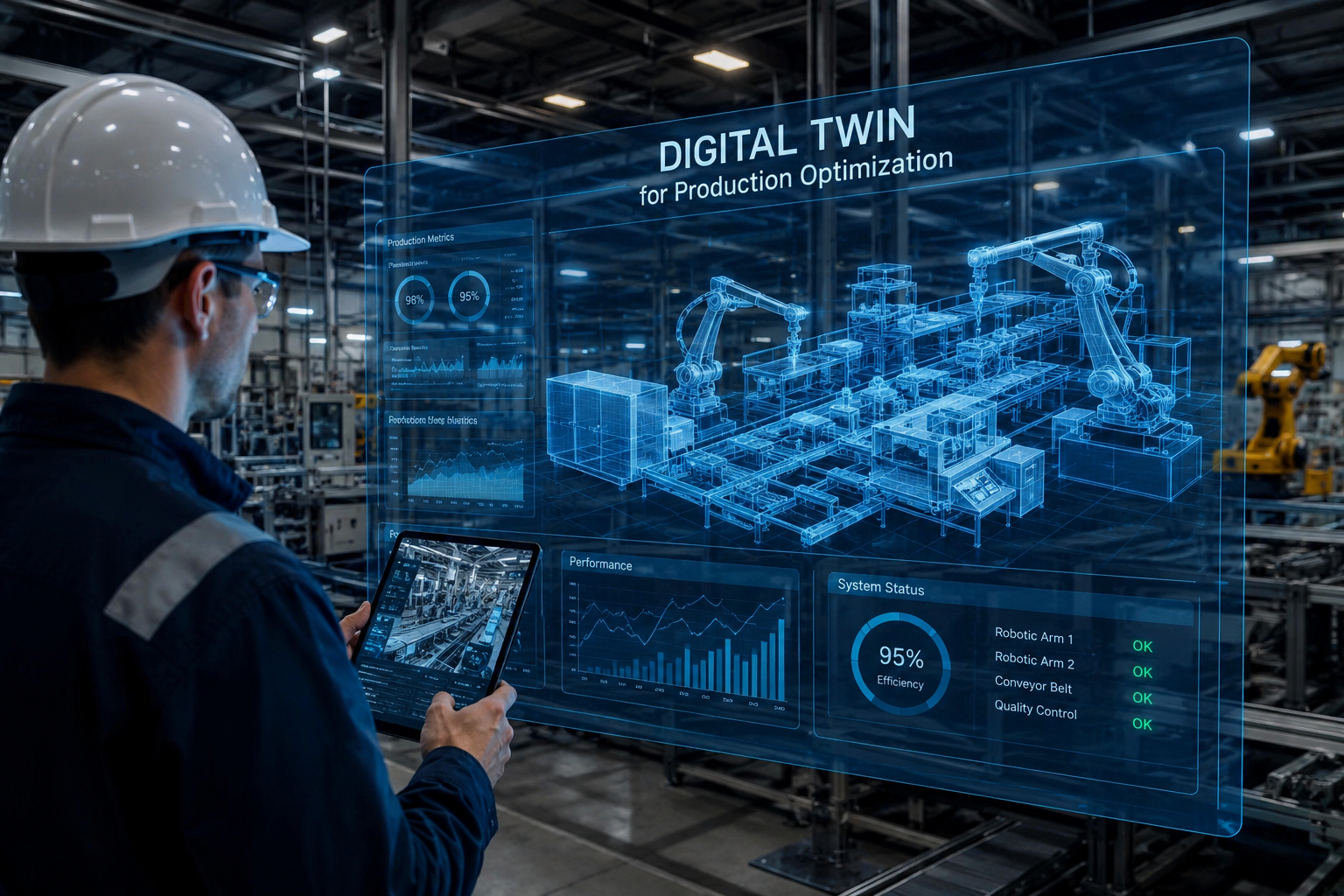
One technology gaining attention in modern manufacturing is the digital twin. By creating a virtual representation of physical production environments, digital twins help teams gain a clearer understanding of how processes, assets, and workflows are connected.
Rather than replacing existing systems, digital twins provide an additional layer of visibility that supports planning, training, operational awareness, and process understanding.
What Is a Digital Twin in Manufacturing?
A digital twin is a virtual representation of a physical asset, process, production line, or manufacturing facility.
It combines visual models with operational information to create a digital environment that reflects real-world manufacturing operations.
A digital twin may represent:
- Production lines
- Manufacturing equipment
- Factory layouts
- Material movement
- Operational workflows
- Facility infrastructure
This allows teams to explore and understand manufacturing environments through a digital interface.
Why Are Manufacturers Exploring Digital Twin Technology?
Manufacturers use digital twins to improve visibility into production environments and better understand how systems, equipment, and workflows interact.
In many facilities, information is distributed across multiple systems and departments. A digital twin can bring operational context together into a visual environment that supports collaboration and decision-making.
Common objectives include:
- Understanding production workflows
- Visualizing equipment relationships
- Supporting training initiatives
- Reviewing facility layouts
- Improving communication between teams
How Does a Digital Twin Support Production Optimization?
Production optimization often begins with visibility.
When teams can clearly see how production assets, workflows, and processes are connected, it becomes easier to identify opportunities for discussion, review, and improvement.
Digital twins support this by helping teams:
Visualize Entire Production Systems
Instead of reviewing separate machines or processes individually, teams can view how different components interact within the broader production environment.
Understand Workflow Dependencies
Production lines often include multiple interconnected activities. Digital twins help illustrate how workflows move through different stages of manufacturing.
Improve Process Awareness
By representing operations visually, teams can better understand production sequences, resource utilization, and operational relationships.
Support Collaborative Reviews
Engineering, operations, maintenance, and management teams can discuss processes using a shared visual reference.
A Practical Manufacturing Example
Consider a manufacturing facility with multiple production lines operating simultaneously.
Traditionally, information may be reviewed through reports, dashboards, equipment screens, and physical observations.
With a digital twin:
- Production layouts can be visualized digitally
- Equipment relationships become easier to understand
- Teams can review workflows within a single environment
- Operational discussions can be supported with visual context
This creates a more connected view of manufacturing operations.
Where Digital Twins Are Used in Manufacturing
Digital twins can support a variety of manufacturing activities.
Production Planning
Teams can review layouts, workflows, and operational sequences before implementation.
Workforce Training
New employees can learn production environments through digital representations of facilities and processes.
Maintenance Awareness
Equipment locations, relationships, and dependencies can be visualized more clearly.
Facility Understanding
Large manufacturing sites can be explored digitally, improving familiarity across departments.
Process Reviews
Teams can discuss production workflows with greater visual clarity.
Digital Twin and Manufacturing Workforce Development
As manufacturing environments become more complex, workforce understanding becomes increasingly important.
Digital twins can support learning by:
- Providing visual process walkthroughs
- Helping employees understand production environments
- Supporting onboarding initiatives
- Enhancing operational awareness
This makes digital twins valuable not only for operations but also for workforce development.
Combining Digital Twins with Immersive Technologies
Digital twins become even more engaging when combined with immersive technologies such as Augmented Reality (AR), Virtual Reality (VR), and interactive visualization environments.
Within this area, Yeppar develops visualization-driven digital twin environments that help manufacturing organizations represent production facilities, workflows, and operational assets in immersive digital formats.
These approaches support understanding, training, and collaboration while working alongside existing manufacturing systems.
Common Misconceptions About Digital Twins
A Digital Twin Is Not Just a 3D Model
While visual representation is important, digital twins focus on representing operational environments and relationships rather than simply displaying 3D graphics.
Digital Twins Do Not Replace Manufacturing Systems
They complement existing systems by providing additional visibility and context.
Digital Twins Are Not Limited to Large Factories
Manufacturing facilities of different sizes can explore digital twin applications based on operational needs.
Why Production Visibility Matters
Manufacturing decisions are often influenced by how clearly teams understand processes and operations.
When workflows, assets, and facility layouts are represented visually, discussions become more informed and collaborative.
Digital twins contribute to this visibility by creating a structured representation of production environments that can be understood across functions and departments.
Conclusion
Digital twins are becoming an important part of modern manufacturing because they help organizations visualize and understand production environments more effectively.
By creating digital representations of assets, workflows, and facilities, digital twins support operational awareness, workforce training, process understanding, and collaborative discussions.
As manufacturing continues to evolve, digital twin technology offers a practical way to connect physical operations with digital insight while maintaining existing production systems and processes.
FAQs
What is a digital twin in manufacturing?
A digital twin is a virtual representation of a physical asset, production process, or manufacturing facility used to visualize and understand operations.
How does a digital twin support production optimization?
It supports production optimization by improving visibility into workflows, equipment relationships, and operational environments.
Can digital twins be used for workforce training?
Yes. Digital twins can help employees understand production processes, facility layouts, and operational workflows.
Do digital twins replace existing manufacturing systems?
No. They work alongside existing systems and provide additional visibility and context.
What industries use digital twins?
Digital twins are used across manufacturing, energy, pharmaceutical, construction, oil and gas, and other industrial sectors.

 Contact Us