

 Agriculture
  Manufacturing
 Automobile
 Pharmaceutical
 RealEstate
 Education
 Events
 Industry 4.0
 Lab Setup
 Training
 Product Demonstrator
 Remote Assistance (MR)
 Virtual Showroom
 Virtual Try on
 Print Media
  Virtual Reality

Introduction
Manufacturing training has traditionally relied on classroom sessions, manuals, and on-the-job learning. While these methods are still used, many organizations are exploring more visual and interactive ways to help employees understand processes and environments.
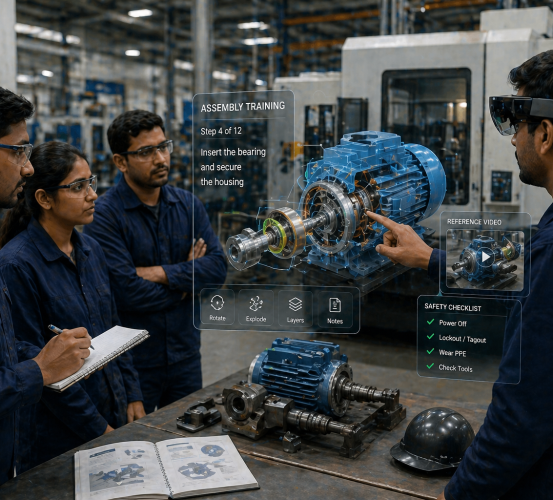
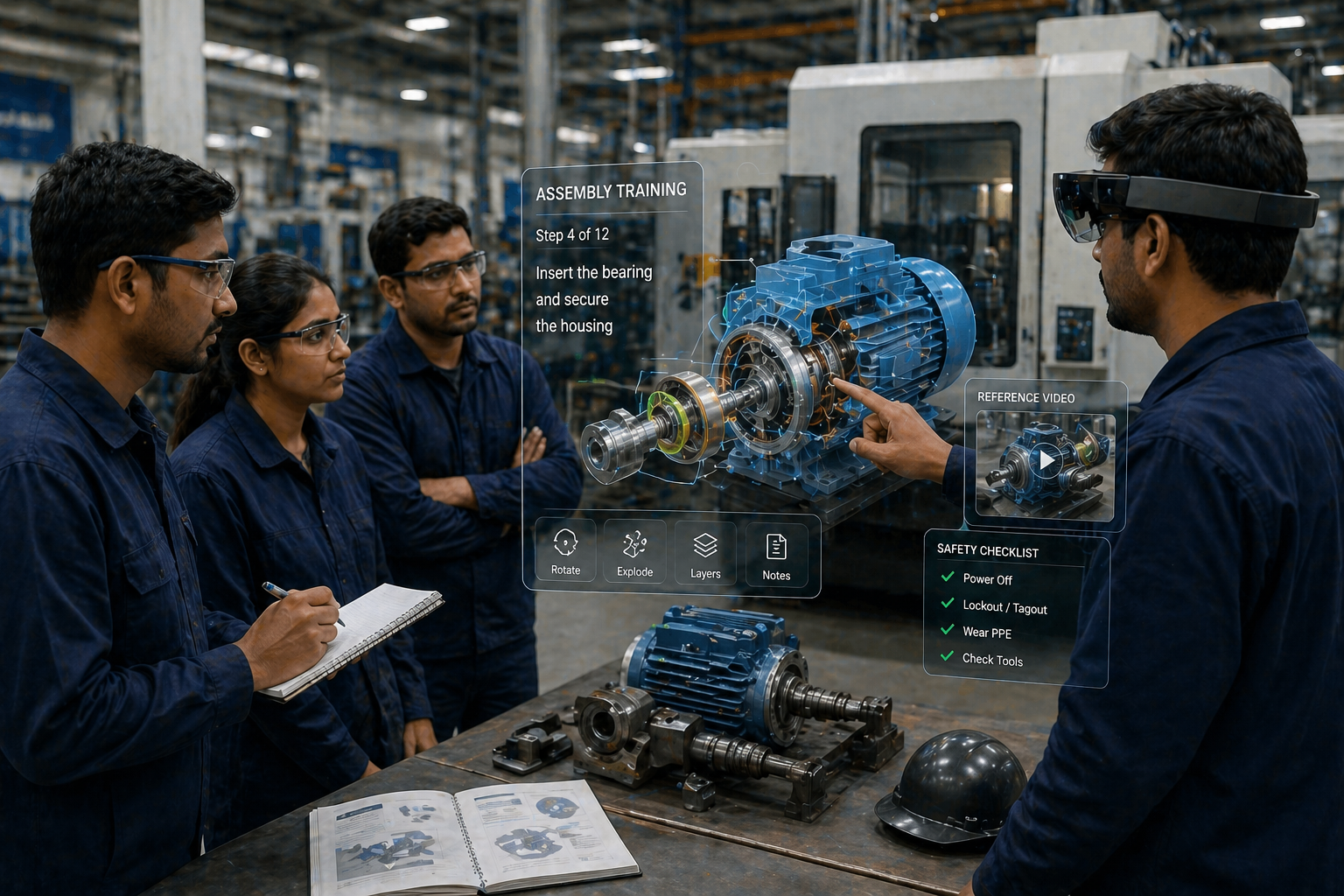
Augmented Reality (AR) and Virtual Reality (VR) are being used as training tools to support learning on the shop floor. These technologies do not replace existing training methods but provide additional ways to make training more visual, structured, and easier to understand.
What Are AR and VR in Manufacturing Training?
Short answer:
AR and VR in manufacturing training are technologies that use digital visuals to help employees learn tasks, processes, and environments in a more interactive and practical way.
- AR (Augmented Reality) overlays digital information onto real-world environments
- VR (Virtual Reality) creates a fully digital environment for training and simulation
Both approaches focus on improving understanding through visualization.
Why Are AR and VR Used in Manufacturing Training?
Manufacturing environments can be complex, with multiple machines, processes, and safety requirements. AR and VR help simplify learning by showing rather than only explaining.
They are used to:
- Provide visual clarity
- Support hands-on learning without risk
- Standardize training across teams
- Improve understanding of processes and workflows
Use Case 1: Operator Onboarding and Basic Training
New employees often need time to understand machines, layouts, and processes.
With AR and VR:
- Operators can explore the work environment virtually
- Basic tasks can be introduced step-by-step
- Learning becomes more structured and repeatable
This helps new employees become familiar with operations before working independently.
Use Case 2: Process and Workflow Understanding
Manufacturing processes often involve multiple steps and dependencies.
AR and VR help by:
- Showing the complete workflow visually
- Explaining how different steps are connected
- Making it easier to understand sequencing
This is useful for both new and existing employees.
Use Case 3: Maintenance and Equipment Training
Maintenance tasks require understanding of equipment and procedures.
With AR:
- Instructions can be overlaid on real machines
- Technicians can follow step-by-step guidance
With VR:
- Maintenance scenarios can be practiced in a simulated environment
This supports clearer understanding of equipment handling.
Use Case 4: Safety Awareness Training
Safety training is an important part of manufacturing.
VR can simulate:
- Hazard situations
- Emergency scenarios
- Safe vs unsafe practices
This allows employees to experience situations in a controlled environment.
Use Case 5: Standardized Work Training
Consistency is critical in manufacturing.
AR and VR support standardized training by:
- Showing the same process to all employees
- Reducing variation in how tasks are taught
- Providing visual reference for correct methods
This helps align training across shifts and locations.
Where These Technologies Fit in Manufacturing
AR and VR are used in:
- Shop-floor training
- Maintenance training
- Safety programs
- Process learning
- Multi-location training setups
They are most useful where processes are complex or require clear visualization.
Supporting Training with Visual Technologies
Many organizations explore digital training approaches to support workforce learning.
In this context, Yeppar provides visualization-based training environments that help manufacturing teams understand processes, equipment, and workflows more clearly.
These approaches support existing training systems rather than replacing them.
Conclusion
AR and VR are practical tools that support manufacturing training by making learning more visual and structured. They help employees understand tasks, processes, and environments in a clearer way.
Instead of replacing traditional training, they add another layer of understanding that supports consistency and awareness across teams.
FAQs
What is AR and VR in manufacturing training?
They are technologies that use digital visuals to help employees learn tasks and processes more effectively.
Where are AR and VR used in manufacturing?
They are used in onboarding, maintenance training, safety awareness, and process understanding.
Do AR and VR replace traditional training?
No. They support and enhance existing training methods.
Are AR and VR difficult to use?
Most systems are designed to be simple and visual, making them easier to understand.
Who benefits from AR and VR training?
Operators, technicians, supervisors, and training teams all benefit.

 Contact Us