

 Agriculture
  Manufacturing
 Automobile
 Pharmaceutical
 RealEstate
 Education
 Events
 Industry 4.0
 Lab Setup
 Training
 Product Demonstrator
 Remote Assistance (MR)
 Virtual Showroom
 Virtual Try on
 Print Media
  Virtual Reality

Introduction
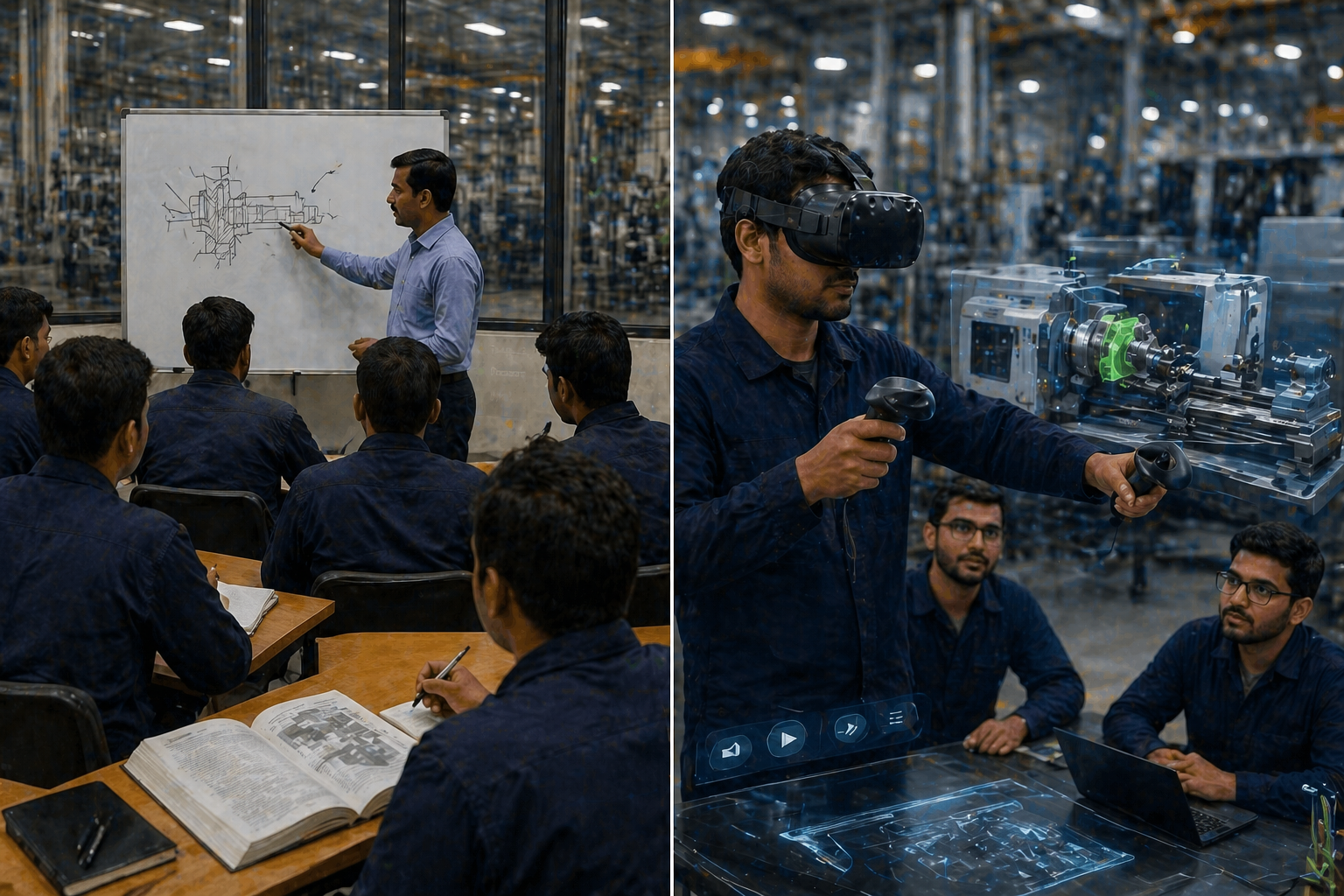
Manufacturing training has evolved over time. For many years, organizations relied on classroom sessions, manuals, and on-the-job guidance to train employees. These methods are still widely used and continue to play an important role.
At the same time, simulation-based training is becoming more common, especially in environments where processes are complex or require clear visualization. Understanding the difference between these approaches helps organizations choose the right method for different training needs.
What Is Traditional Training in Manufacturing?
Short answer:
Traditional training refers to methods such as classroom learning, printed manuals, and direct instruction from supervisors or experienced operators.
It typically includes:
- Classroom sessions
- Standard operating procedures (SOPs)
- Demonstrations by supervisors
- Learning through observation
This approach focuses on explaining tasks and guiding employees through real work situations.
What Is Simulation-Based Training?
Short answer:
Simulation-based training uses digital environments to replicate real manufacturing processes, allowing employees to learn tasks through interactive and visual experiences.
It may include:
- Virtual environments representing shop floors
- Interactive scenarios
- Step-by-step guided simulations
- Visual process walkthroughs
This approach focuses on learning by experiencing processes in a controlled environment.
Key Differences Between the Two Approaches
Learning Method
Traditional training relies on explanation and observation.
Simulation-based training relies on interaction and visualization.
Training Environment
Traditional training happens in classrooms or on the shop floor.
Simulation training happens in digital or virtual environments.
Consistency
Traditional training can vary depending on the trainer.
Simulation training follows a predefined structure.
Learning Experience
Traditional methods depend on listening and watching.
Simulation allows employees to engage and explore.
When Traditional Training Works Best
Traditional training is effective when:
- Tasks are simple and repetitive
- Direct supervision is available
- Training needs to happen quickly on the job
- Employees already have basic knowledge
It remains useful for foundational learning and immediate guidance.
When Simulation-Based Training Is Useful
Simulation-based training is helpful when:
- Processes are complex or involve multiple steps
- Visualization improves understanding
- Training needs to be standardized
- Employees need to practice before real work
It is often used to support deeper understanding of workflows and systems.
Combining Both Approaches
In many manufacturing environments, the most practical approach is to combine both methods.
For example:
- Use simulation to explain processes and workflows
- Use traditional training for real-world practice
- Reinforce learning through supervisor guidance
This combination helps balance understanding and application.
Supporting Training with Digital Tools
As training methods evolve, organizations are exploring digital tools that support both traditional and simulation-based learning.
In this space, Yeppar provides visual and immersive training environments that help manufacturing teams understand processes more clearly while supporting existing training methods.
These tools are used to enhance clarity and consistency without replacing established practices.
Conclusion
Traditional and simulation-based training both play important roles in manufacturing. Each approach has its own strengths, and their effectiveness depends on how they are used.
Rather than choosing one over the other, many organizations use a combination of both to support learning, improve understanding, and maintain consistency across teams.
FAQs
What is traditional training in manufacturing?
It includes classroom learning, SOPs, and supervisor-led instruction on the shop floor.
What is simulation-based training?
It uses digital environments to help employees learn tasks through visual and interactive experiences.
Which training method is better?
Both have their advantages. The choice depends on the type of task and learning requirement.
Can both training methods be used together?
Yes. Many organizations combine them for better results.
Who benefits from simulation-based training?
Operators, technicians, supervisors, and training teams.

 Contact Us